+

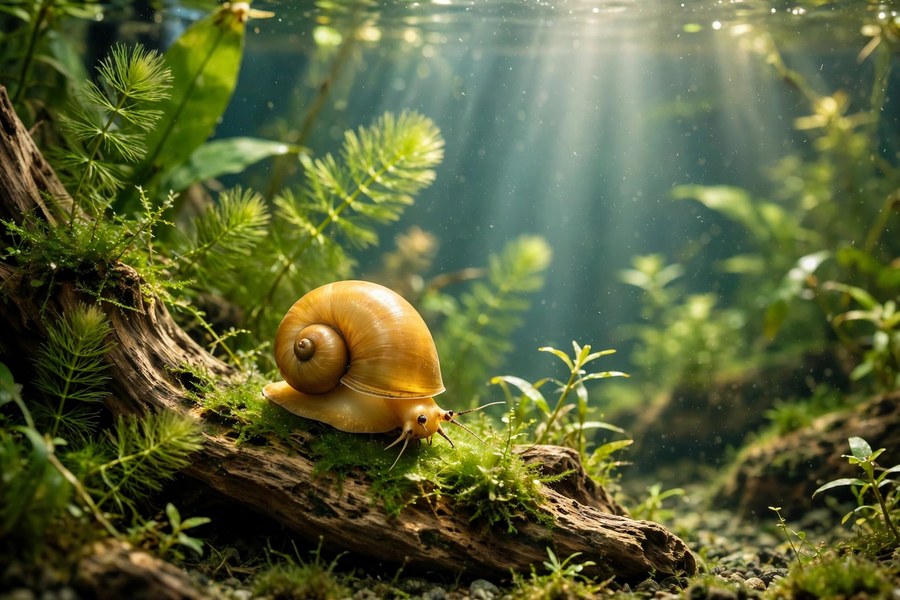
So why keep mystery snails? Most people get them because they hear the snails are really good at cleaning algae. They are — but that is only half the story. They are also peaceful scavengers, they come in a rainbow of shell colours, and they are genuinely fun to watch. Here is how to keep them successfully, from water chemistry to tank mates.
Key takeaways
Mystery snails do not get super huge — you are looking at an inch and a half, maybe two inches at most. The colouration is where they shine: gold, black, blue, and shells with patterns, sometimes with a green tint where a little algae has grown on them. A 20-gallon long tank makes a great home for a few snails alongside guppies, and it can even become a productive breeding tank.
What people really enjoy about them is the cleaning crew work: they graze algae off surfaces, work through detritus, and eat dead plant leaves — all while being super peaceful. They will not bother your fish or your healthy plants. In a planted tank, a snail quietly pruning dying leaves while the plants grow is exactly the kind of low-drama help a keeper wants.
Because they are so peaceful, tank mates have to be chosen with the snails in mind, not the other way around. Small tetras, guppies, rasboras, hatchet fish and freshwater shrimp are all good company, as are bristlenose plecos. The rule is simple: small, non-aggressive fish that feed in midwater and topwater are the least likely to make a snack out of your snails.
| Tank mate | Verdict |
|---|---|
| Small tetras, guppies, rasboras, hatchet fish | Good — peaceful, midwater/topwater feeders |
| Freshwater shrimp, bristlenose plecos | Good — peaceful bottom dwellers (take care if breeding snails) |
| Cichlids (almost all types) | Avoid — will eat the snails or pick at them |
| Loaches | Avoid — snail eaters by nature |
| Semi-aggressive fish | Avoid — stress and harassment shorten snail life |
Standard aquarium temperatures in the 70s Fahrenheit suit mystery snails fine. What really matters is water chemistry: they are very sensitive to ammonia, nitrites and nitrates, so keep all three under control. pH is the other big one — if the pH runs too low, their shells start to break down, because the calcium carbonate they need to keep shells healthy dissolves in acidic water. Aim above neutral, ideally in the upper 7s. Water hardness matters for the same reason: soft-water keepers are often the ones who report bad luck with snails, and hardness is usually the missing piece.
| Parameter | Target for mystery snails |
|---|---|
| Temperature | 70s °F (standard tropical range) |
| pH | Above 7, ideally upper 7s |
| Ammonia / nitrite / nitrate | As low as possible — snails are very sensitive |
| Water hardness | Hard water preferred — supports shell calcium |
Snails are really easy to feed, and that is exactly the trap. People buy them for algae control, the snails do the job beautifully — the keeper stops scraping algae entirely — and then the food runs out. Once the algae is under control, you must feed them: drop in algae wafers and sinking pellets after the lights go off, enough that everything is gone by morning. If food is still there at breakfast, you fed a little too much. Starvation is one of the things that can genuinely kill snails, and it happens quietly, after the tank looks its cleanest.
Most internet sources say a 5- to 10-gallon tank is a good minimum, but a 10-gallon or larger tank is a better home for one or two mystery snails. Decor matters, too: surface area is a gift, because it lets biofilm and algae grow for the snails to graze. Driftwood, rocks and live plants all work wonderfully in a 20-gallon setup — and the snails will eat the dying leaves for you.
Two safety rules are non-negotiable. First, keep a tight-fitting lid: mystery snails will climb out of an open tank, and that never ends well. Second, watch the filter intake — snails inevitably wander over and get their heads stuck in it, which means shutting the filter down and removing the intake to free them. Sponge filters are a very safe choice here, and any intake should wear a sponge cover. Hang-on-back filters work too, as long as the intake is protected.
A mystery snail gliding over a piece of natural driftwood from CozyWoodLab, grazing algae in the warm light of a planted tank, is one of the quietest pleasures in the hobby — a little cleaner, a little colour, and almost no trouble at all.
Tip: feed your snails after lights-out with algae wafers or sinking pellets. If everything is gone by morning, the portion was right — and you have just prevented the most common cause of mystery snail loss: starvation after the algae is gone.