+

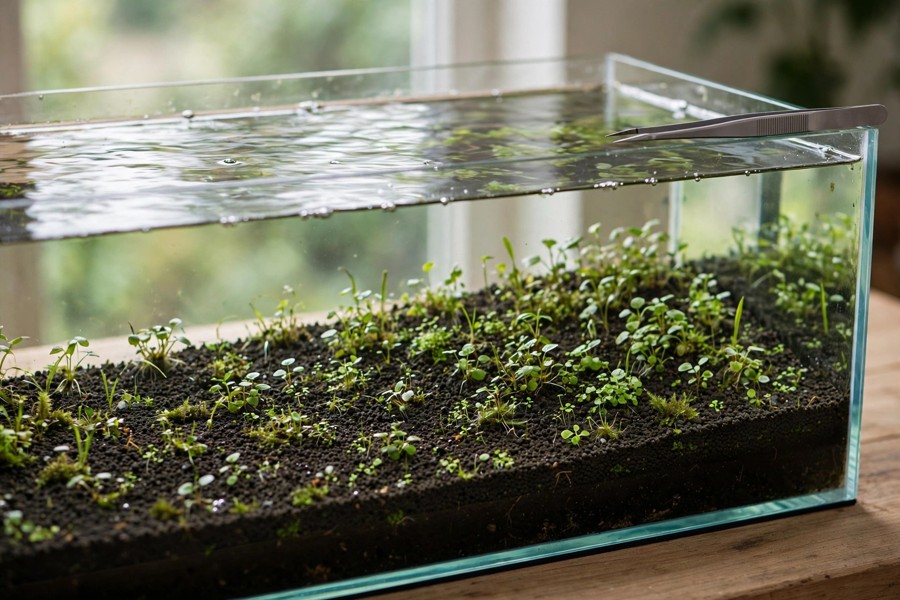
You plant a carpet with tweezers, wait a week, and half of it is floating at the surface while the rest turns translucent and mushy. Before blaming the light or the temperature, look down: most beginner plants do not die from bad lighting — they starve in the wrong substrate. The ground your plants sit in is their dinner table, and plain gravel serves nothing.
Key takeaways
The difference comes down to one word: active. Inert gravel just sits there. Active soil changes the water around it, feeds the roots in it, and gives fragile root systems something porous to hold on to.
| Factor | Inert gravel / sand | Active aquasoil |
|---|---|---|
| Nutrient content | None | High — feeds roots continuously |
| pH effect | Neutral | Buffers toward soft, slightly acidic |
| Root grip | Poor — smooth, hard surface | Excellent — porous granules |
| Best for | Column-feeding epiphytes, fish-only tanks | Root-feeding and carpeting plants |
| Setup complexity | Low | Requires a fishless cycling period |
Standard aquarium gravel and basic play sand are completely inert — zero nutritional value, basically tiny rocks holding decorations in place. Plant a heavy root-feeder in plain gravel and you are asking it to grow in broken glass: nothing to eat, and a smooth, hard surface that gives fragile roots nothing to grip. The roots rot, the plant floats, and the keeper blames everything except the substrate.
That does not make gravel useless. Column-feeding epiphytes such as Anubias and Bucephalandra draw nutrients from the water, not the ground, so they are perfectly happy attached to wood or stone above inert gravel. The trap is only for root-feeders and carpeting plants — the very plants beginners most want to grow.
Aquasoil is made from fermented, nutrient-rich earth baked into small, stable granules. As soon as roots reach those dark granules, they have immediate access to dense nutrition — no endless bottles of liquid fertiliser required. Its porous structure lets fragile roots grip, spread and anchor, which is why carpets stay planted instead of drifting up overnight.
It is called active because it also alters water chemistry, naturally buffering pH downward and softening hard water. That soft, slightly acidic sweet spot is where aquatic plants explode with growth — and it happens to be the same environment sensitive soft-water shrimp need to breed successfully. For a shrimp-and-plant tank, the substrate is doing double duty.
Aquasoil is sold by weight, but coverage depends on your tank's footprint and slope depth — a standard 2-inch depth for a 10-gallon tank needs meaningfully more than a small sample bag. Check the bag weight against your tank's dimensions before ordering; a little extra beats running short mid-scape.
More importantly, fresh aquasoil leaches ammonia for the first few weeks. That ammonia jump-starts plant growth, but it will harm livestock added too soon. Run the tank fishless for roughly three to six weeks until ammonia tests read zero, and ignore any advice claiming shrimp are safe after just a week. This waiting period doubles as your tank's cycle, so patience here pays twice.
One more compatibility note: active soil suits soft-water species like tetras, rasboras and dwarf cichlids beautifully, but it works against fish that need high pH and hard water, such as African cichlids and certain livebearers. Match the substrate to the livestock, not just the plants.
Building a stunning underwater garden gets easier once you stop fighting your substrate. Give those roots real food to dig into, be patient while the tank cycles, and watch your glass box come alive — especially when the planting sits on a natural driftwood hardscape from CozyWoodLab, where the wood and the roots grow into one scene.
Tip: never rinse aquasoil, and never fill straight onto it. A plastic sheet over the substrate diffuses the water flow, keeps your slope intact and saves you from a cloudy tank on day one.