+

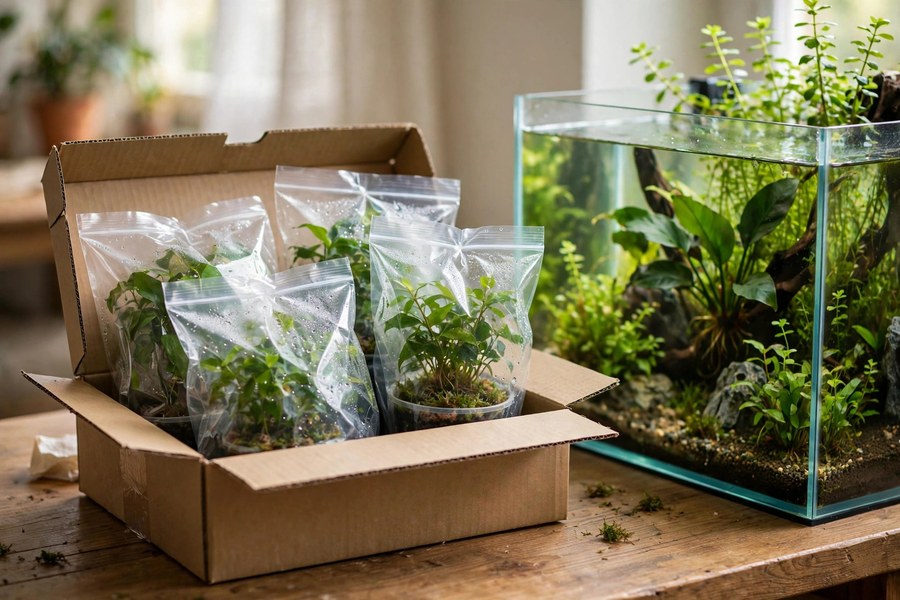
You found the plant. Great photo, good price, one click away — and then the little voice asks: what actually shows up at your door? Everyone in this hobby has a story about the sad brown mush that arrived in a bag, or the box that baked on a porch all afternoon. Buying live plants online works beautifully when you know what separates a real plant seller from someone drop-shipping greenery. Here is the checklist to run before you order.
Key takeaways
| # | What to check | Why it matters |
|---|---|---|
| 1 | A written DOA guarantee | Your only protection if transit goes wrong |
| 2 | Heat packs / cold packs | Weather kills more plants than shipping does |
| 3 | Ship-out speed | Every extra day in a box is stress |
| 4 | Proper species names | Tells you whether they know their plants |
| 5 | Real photos | Stock images hide actual quality |
| 6 | Pest and snail handling | One hitchhiker can overrun a tank |
| 7 | Reachable support | Someone has to answer when it goes sideways |
This is the big one. Any seller shipping living things should tell you, in writing, what happens if your plant arrives dead. Vague promises do not count — look for the specifics: how long you have to report it, what proof you need, and what you get back. A solid policy usually asks for a photo within about 12 hours of delivery, with the item still sealed in its original packaging, in exchange for a refund or store credit. Whoever you buy from, read that fine print before checkout, not after.
Here is the thing most first-time buyers miss: weather is the real enemy, not the shipping company. A box in a summer heatwave or a freezing January is a small oven or freezer with your plants inside. Good sellers offer heat packs seasonally, and a fair number will not honour a DOA claim if a heat pack was recommended and you skipped it. That sounds strict until you realise it is exactly how a seller who has watched a lot of winter orders behaves. Take the heat pack in cold months, even if it feels like an upsell.
A plant sitting in a warehouse for four days before it even moves has already had a rough week. Look for a stated ship-out window — one to three business days is a solid benchmark — and tracking you can follow. Fast dispatch matters because every extra day sealed in a dark box is stress the plant has to recover from later.
Small tell, big signal. A listing that says "Amazon Sword (Echinodorus bleheri)" comes from someone who knows their catalogue. A listing that just says "aquarium plant — green" does not. Proper species names also save you from the classic mistake of planting an epiphyte in the substrate and wondering why it rots. If a shop cannot name what it sells, it probably cannot tell you how to keep it alive either.
Stock photography is a red flag on anything living. You want to see actual plants — and even better, customer photos showing what genuinely arrives. That gap between the marketing shot and the real thing is where most disappointment lives. A seller proud of its stock shows it as it is, roots, pots and all.
Pond snails and pest hitchhikers travel on plants. It is not a dealbreaker, but a seller should be upfront about how plants are grown and handled. If they do not mention it at all, plan to dip and quarantine anything you receive — unless you are buying sterile tissue cultures, always assume a dip is needed. Our guide on quarantining new plants walks through the routine step by step.
Live plants are unpredictable. What separates a good store from a bad one usually is not whether something goes wrong — it is whether someone answers when it does. Check for a visible contact route and a real policy page before you spend. A shop with no way to reach a person is a shop that will not be there when your box arrives half-melted.
Bring the box indoors immediately, photograph the contents, then let the plants come to room temperature before any water contact. Thermal shock does more damage than the trip itself. Once they are settled, dip and quarantine as usual, then plant them into your scape — ideally onto a natural driftwood hardscape from CozyWoodLab, where the wood gives epiphytes something real to grip and the whole layout looks like it grew there.
Tip: photograph your plants the moment you open the box, while they are still sealed in their original packaging. That one photo is your best insurance under any written DOA policy — and the claim window is often as short as 12 hours.