+

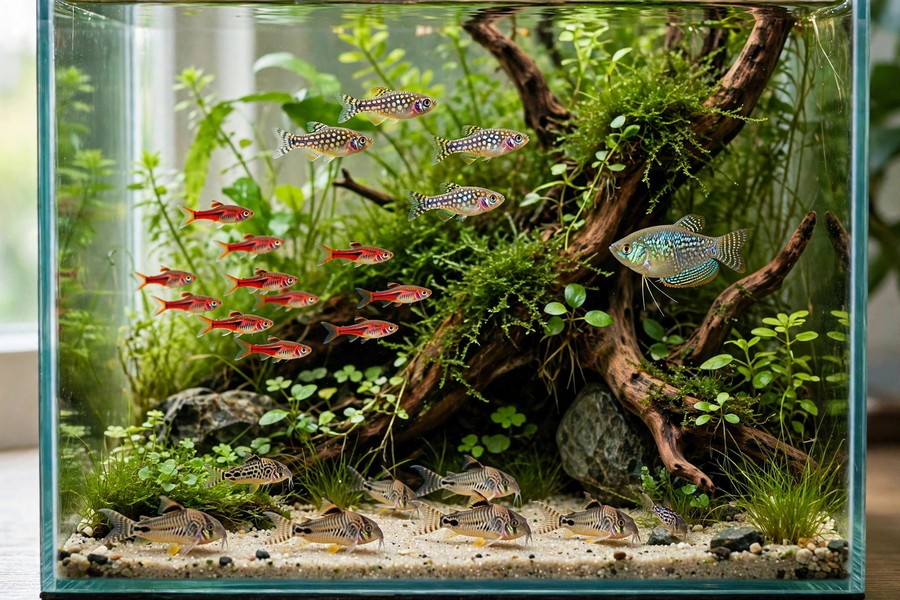
A nano tank does not mean boring fish. Some of the most colourful, characterful species in the hobby stay under two inches, and a well-chosen group can make a 10-gallon aquarium feel like a miniature river. This guide walks through twelve small favourites from Aquarium Co-Op's list, grouped by where they swim and what they need, so you can pick a community that actually works together.
Key takeaways
First, group size beats headcount. Six pygmy corydoras will be bolder, healthier and more fun to watch than two each of three species. Second, check the temperature overlap before mixing species: the list below spans from white clouds that tolerate near-freezing water to apistogrammas that prefer 82–85°F, and those two worlds do not mix.
Third, stock by water layer. A bottom crew, a midwater school and a top-dwelling pair use different parts of the tank, so a small aquarium can hold more life without feeling crowded. That layering is also why a planted layout matters: plants break sight lines and give shy fish somewhere to retreat, as our guide to cycling a planted aquarium explains before you add any fish at all.
Pygmy corydoras are tiny, social catfish that patrol the substrate in a group, keeping the bottom tidy as they go. They are hardy across 70–80°F and a pH of 6.5–8.0, affordable, and happiest in groups of six or more. If you want one bottom species for a first nano tank, this is the safest pick.
Kuhli loaches are the playful alternative: eel-like, endlessly curious, and fond of hiding until they decide to explore. Keep at least three together, in 72–82°F water at pH 6.5–8.2, and give them soft substrate and hiding spots. They spend much of the day out of sight, which makes their evening appearances a genuine event.
Celestial pearl danios, often still called galaxy rasboras, are one of the most striking small fish available, with intricate spotted patterns that reward a planted tank. They prefer cooler water, 68–78°F, pH 6.5–8.0, and groups of six or more. Chili rasboras bring the opposite energy: tiny, fiery red, and most vivid in a well-kept, heavily planted tank at 72–82°F, though breeding them is genuinely challenging.
Neon green tetras are even smaller than classic neons, with a mesmerising green sheen best seen from above, at 74–82°F and pH 6.5–7.8. White cloud mountain minnows are the hardy classic of the group, available in normal, gold and long-finned forms, tolerating an extraordinary 30–90°F range and any pH above 6.5 — they will even overwinter in outdoor ponds. Red neon rainbowfish are the premium option: small, bright and active, happiest in warm 70–82°F water in a group, where males colour up best.
Fancy guppies and Endlers round out the midwater choices with a rainbow of colours and famously easy breeding. They prefer harder, more alkaline water — 72–82°F, pH above 7.0 up to 8.5 — and a single pair can produce plenty of fry, so keep more females than males to spread the males' attention.
Clown killifish live at the surface like miniature rockets, males in bright colours and females more muted. They are jumpers, so a well-fitting lid is essential, and they enjoy small floating foods such as baby brine shrimp and frozen Cyclops across 68–80°F and pH 6.5–8.2. Sparkling gouramis are subtler: an iridescent glow in the right light, a habit of stalking food like tiny predators, and even a taste for pest hydra, at 72–80°F and pH 6.5–7.8.
Apistogramma dwarf cichlids are the most interactive pick on the list, but also the most demanding: a pair needs soft, warm water, ideally 82–85°F and pH 6.5–8.0, and rewards good care with fascinating behaviour and fry. Watch out for sneaker males, which look and act like females until they mature. Shell-dwelling cichlids (Neolamprologus multifasciatus) are the opposite extreme: tiny African cichlids that dig, rearrange and defend shells in hard, high-pH water of 72–82°F and pH 7.0–8.5, best kept species-only with a group of six and plenty of shells.
| Species | Temperature | pH | Group size |
|---|---|---|---|
| Pygmy corydoras | 70–80°F | 6.5–8.0 | 6 or more |
| Clown killifish | 68–80°F | 6.5–8.2 | Pair or small group |
| Celestial pearl danio | 68–78°F | 6.5–8.0 | 6 or more |
| White cloud mountain minnow | 30–90°F | Above 6.5 | Pair can spawn |
| Chili rasbora | 72–82°F | 6.5–8.0 | 6 or more |
| Neon green tetra | 74–82°F | 6.5–7.8 | 6 or more |
| Guppies & Endlers | 72–82°F | 7.0–8.5 | More females than males |
| Sparkling gourami | 72–80°F | 6.5–7.8 | Pair or small group |
| Kuhli loach | 72–82°F | 6.5–8.2 | 3 or more |
| Apistogramma | 82–85°F | 6.5–8.0 | One pair |
| Shell dwellers (multis) | 72–82°F | 7.0–8.5 | Group of 6 |
| Red neon rainbowfish | 70–82°F | 7.0–8.0 | Group |
Many nano fish breed with little encouragement. White clouds will usually spawn on their own and make more, guppies need no help at all, and clown killifish and celestial pearl danios are relatively easy to breed if you aim for the middle of their temperature and pH ranges. Apistogramma pairs and shell dwellers can both produce lots of fry once settled, while red neon rainbowfish need a floating spawning mop and very tiny powdered fry food with a long grow-out.
The honest exception is the chili rasbora: easy to keep, hard to breed, and worth sharing your method with the community if you succeed. And remember that fry change the stocking maths fast — a tank that looks calm with one guppy pair will not stay that way for long, so have a plan for the babies.
Whatever species you choose, give them a home worth showing off: a natural driftwood hardscape from CozyWoodLab, soft plants and shaded corners turn a small glass box into a landscape, and that is when nano fish behave at their best. If you are still deciding on tank size, our guide to choosing your first or next aquarium helps you match the tank to the fish, not the other way round.
Tip: never mix the cool-water and warm-water ends of this list. White clouds and celestial pearl danios thrive in the 60s and low 70s, while apistogrammas want the low 80s — pick one temperature band for the whole tank and choose every species inside it.