+

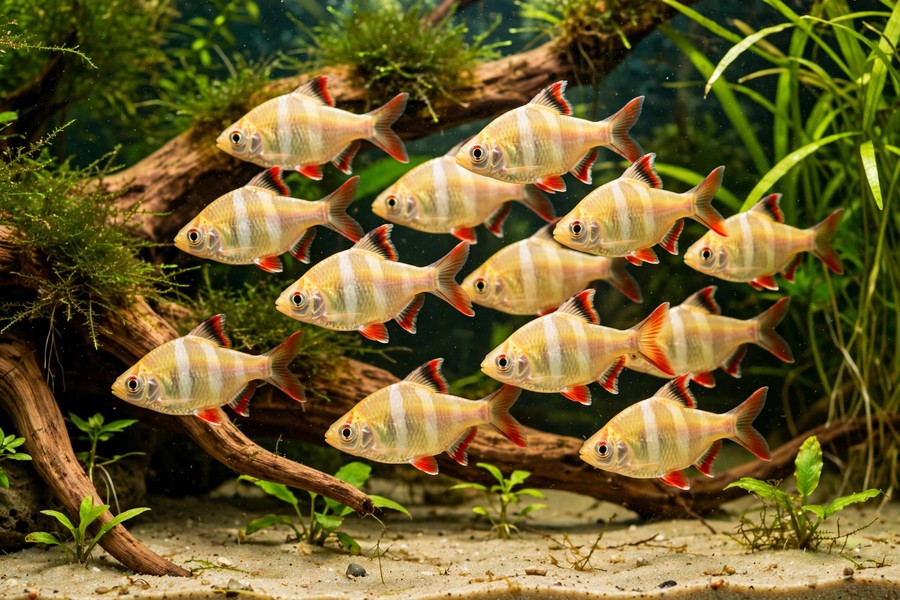
Albino tiger barbs are the softer, paler cousins of one of the hobby's liveliest schooling fish: creamy yellow bodies, whitish stripes and bright red fins, with all the energy of the classic tiger barb. They are hardy, beginner-friendly and endlessly entertaining — provided you keep them in a proper school and away from slow, long-finned tankmates. Here is everything the species needs, from strains to spawning.
Key takeaways
The albino tiger barb is a colour morph of the tiger barb (Puntius tetrazona), with a yellow or creamy background and whitish stripes instead of the classic black bars. Several strains exist, including gold and platinum body colours, all with beautiful red accents on the nose and fins. Mature specimens may fade slightly, but a school in a large aquarium still makes an awesome display.
One physical quirk sets albinos apart: they do not always have gill covers. When the hobby first met them, reactions were mixed — some aquarists loved them, others were indifferent — so they stayed less popular than standard tiger barbs. With the newer red, gold and platinum strains, they are becoming more sought after again.
| Strain name | Look | Notes |
|---|---|---|
| Gold tiger barb | Warm golden body | One of the most widely sold albino strains |
| Golden platinum tiger barb | Pale, metallic sheen | A brighter, showier variant |
| Albino golden tiger barb | Creamy gold with pale stripes | Classic albino look |
| Red tiger barb | Stronger red tones | Red accents on nose and fins |
| Blood red tiger barb | Deepest red version | The most dramatic of the strains |
Albino tiger barbs are active, fast-swimming fish that must be kept in schools of at least six or seven. In a proper school, their energy goes into chasing each other; kept singly or in small groups, nippy behaviour is common, and other fish pay the price. They are easy to keep and hardy when the water is clean with regular changes, which makes them great for aquarists of all experience levels.
Choose tankmates with the same energy: other active species, including a mixed school of albino and regular tiger barbs for a beautiful contrast, or longfin and green tiger barb varieties for extra variety. Avoid slow or long-finned fish such as gouramis and angelfish — they are exactly the targets a bored barb will nip. If you keep angelfish elsewhere, our angelfish care guide explains the calm, planted setup those elegant fish actually prefer.
Tiger barbs come from the Malay Peninsula, Sumatra and Borneo, possibly also Thailand and Cambodia, where they swim in quiet forest streams with clear, oxygen-rich water. In nature they live over sand and rocks with dense vegetation, eating insects, diatoms, algae, small invertebrates and detritus. The albino variant, by contrast, is purely captive-bred, with no known wild populations.
That wild background explains the tank they want: a sandy substrate, bogwood for a natural habitat feel, plants especially along the sides and back, and open swimming areas in the middle, where they prefer to swim. Efficient filtration and good water movement help males show their best colouration.
Albino tiger barbs have a round, deep body with a high back and a pointed head, growing to around 7 cm, usually smaller in aquariums, and living 6–7 years with proper care. The body is creamy or yellow with reduced whitish stripes, red highlights on the dorsal, tail and ventral fins, and a bright red snout on males during spawning.
They are great for beginners, but with one honest caveat: albinos are slightly weaker than regular tiger barbs and more prone to disease if water quality slips. Clean water is crucial — they are susceptible to ich — so regular maintenance is not optional. A steady low-effort maintenance routine is the simplest insurance, with 20–25% water changes monthly, or biweekly if the tank is heavily stocked.
Albino tiger barbs are omnivores that will eat live, fresh and flake foods. A high-quality flake food makes a fine daily diet, with brine shrimp and bloodworms as treats. The feeding rule is strict because they will eat as much as offered: only what they finish in 3 minutes if you feed multiple times a day, or 5 minutes for a single daily feed. Overfeeding fouls the water fast, and these fish are the first to suffer for it.
Because they stay under 3 inches, the minimum tank size is 15 gallons, but 30 gallons is ideal — a school of fast swimmers needs room to move. Make sure the tank is covered, since they can jump, well-filtered, planted, and furnished with open swimming space plus sandy substrate and bogwood. A natural driftwood centrepiece from CozyWoodLab suits them perfectly: it recreates the shaded, wood-strewn streams they come from while leaving the middle of the tank open for schooling.
| Setup point | Recommendation | Why it matters |
|---|---|---|
| Tank size | 15 gallons minimum, 30 ideal | Room for a fast school to swim |
| Lid | Fitted cover | They can jump |
| Substrate | Sand, plus bogwood | Matches their natural stream habitat |
| Planting | Sides and back, open middle | Shelter without blocking swimming space |
| Filtration | Efficient filter, good flow | Clean water and brighter male colour |
Females are heavier, especially during spawning, while males are smaller, more brightly coloured, with red noses in spawning condition. Breeding is moderately easy, and fish mature remarkably early: sexually mature at 6–7 weeks, at around three-quarters to one inch long. They are egg scatterers with no specific breeding site, so the spawning tank does the work instead.
Set up a 20-gallon spawning tank with a sponge filter, a heater and marbles as substrate to protect the eggs, at pH around 6.5 and 74–79°F. Add the female first and the male after a few days; courting happens in the afternoon and spawning in the morning, just one to three eggs at a time, though a mature female can release more than 700 eggs in total. Remove the parents afterwards to prevent egg eating: eggs hatch in 48 hours, fry swim freely in five days, and feed them infusoria, liquid fry food or baby brine shrimp three times daily, watching leftovers closely since they foul the water quickly.
Albino tiger barbs are hardy, but poor water quality leads to ich, and anything added to the tank — fish, plants or substrate — can introduce disease. Always quarantine or clean new additions, and remember that outbreaks caught early stay limited. The formula is simple: a clean tank, a balanced diet and low stress, with early detection the key to minimising any problem. New plants deserve the same caution, which is why our dip-and-quarantine guide is worth following before anything new enters the tank.
Tip: if your barbs start nipping, do not blame the fish — count the school first. A group below six is the most common cause of fin-nipping, and adding more barbs usually fixes the behaviour faster than removing the 'bully'.