+

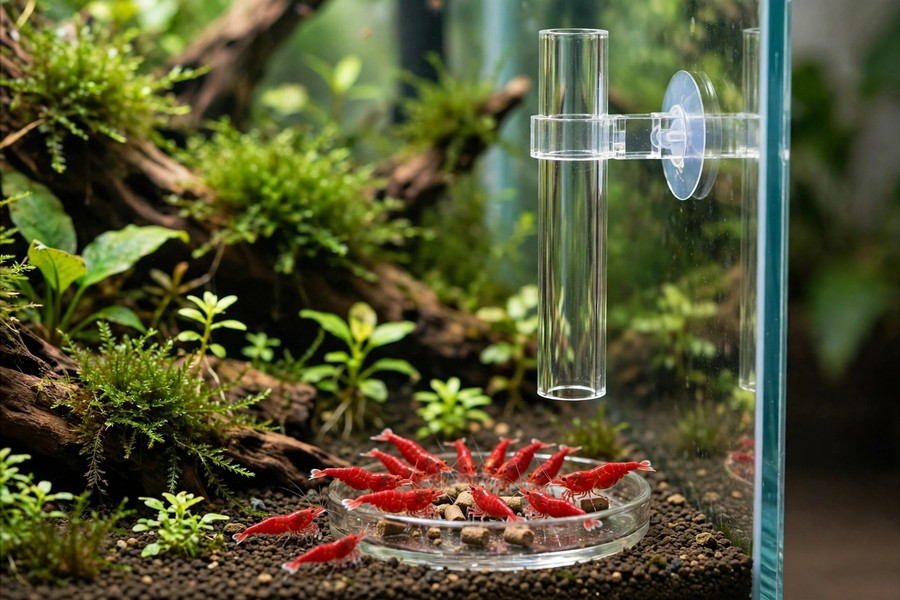
Dropping food into a shrimp tank should be simple, yet anyone who keeps dwarf shrimp or shy bottom-dwellers knows the frustration: the filter blows expensive sinking pellets into the darkest corner of the aquasoil, and what the shrimp never find rots in the substrate, spikes ammonia and feeds algae. A clear aquarium feeding tube fixes that with almost embarrassing simplicity — food goes straight down to one exact spot, every time.
Key takeaways
We have all done the classic pinch-and-drop: grab a pinch of shrimp food or sinking wafers, toss it in, hope for the best. The problem is that the filter current treats it like confetti. By the time food actually reaches the bottom, it is scattered everywhere — messy to look at, twice as hard for shrimp to find, and worst of all, tiny particles work deep into the substrate where the cleanup crew cannot reach them, sitting there and slowly rotting away your water quality.
That hidden rot is not just untidy. Uneaten food breaking down in the substrate releases ammonia, and the nutrient spike that follows is exactly what algae loves — so a sloppy feeding routine can end as an algae bloom you never asked for. If algae is already a problem, our algae identification guide helps you match the algae type to its root cause, and feeding waste is one of the first causes to check.
A transparent feeding tube fixes the scatter outright. Because it is clear, it blends into the background instead of standing out as another piece of visible equipment. Mount it to the glass, drop food into the open top, and watch it sink straight down to the exact spot you want — no drifting, no mess.
The wide top funnel sits above the waterline, so you can drop sinking pellets straight down without even getting your fingers wet. Tubes come in multiple length options, so whether you run a shallow breeder tank or a tall display, you can find a fit that reaches the substrate properly. And there is a side benefit nobody mentions enough: once your animals learn that food always arrives in one spot, they start gathering there reliably, which makes feeding time far more fun to watch.
One caution about flow: even with a tube, strong filter current can still scatter micro-particles while livestock eat. Our guide to telling if aquarium water flow is too strong helps you judge whether your circulation suits a feeding station, or whether a brief pause at mealtimes is the smarter move.
| Step | What to do | Why it works |
|---|---|---|
| Pair it with a feeding dish | Drop food into a dish, not bare substrate | Contains the mess completely instead of just narrowing where it lands |
| Kill the filter flow for 5 minutes | Pause flow while livestock eat | Prevents micro-particles from scattering |
| Remove leftovers after 2 hours | Lift out anything uneaten | Stops uneaten food from rotting and fouling water quality |
The dish half of the pairing matters as much as the tube: a feeding dish gives the tube somewhere precise to drop food into, and the two together turn feeding time into a fully contained, zero-drift routine instead of a game of substrate roulette. It also makes removal easy — lift the dish, and the leftovers come with it, instead of hunting for crumbs in the gravel.
Yes. These tubes are built from aquarium-safe clear materials that will not leach anything into your water — check your specific listing for the exact material, since options vary between clear acrylic and glass depending on the model.
A cheap, flexible wire pipe brush works well. Run it through with warm water roughly once a month to clear out slimy biofilm buildup before it accumulates and clouds the clear material.
Some feeding tube designs include a barrier feature near the top specifically to stop aggressive top-water fish from diving down and stealing shrimp food — check your specific model's features if this is a concern in your tank.
No more than about two hours. Beyond that, uneaten food starts breaking down and contributing to ammonia buildup regardless of how well-contained it was. Keeping water crystal clear and the substrate spotless does not mean underfeeding your livestock — it means feeding precisely, and removing what is not eaten.
A simple, transparent feeding tube makes mealtime precise and clean, and it pairs naturally with the rest of good husbandry: a steady low-effort maintenance routine for the tank around it, and a natural CozyWoodLab driftwood scape that gives shrimp the grazing surfaces and shaded corners they love between meals.
Tip: set a phone timer for two hours at feeding time. The two-hour removal rule is the single most skipped step in zero-waste feeding, and it is the difference between a clean feeding station and a hidden ammonia source.