+

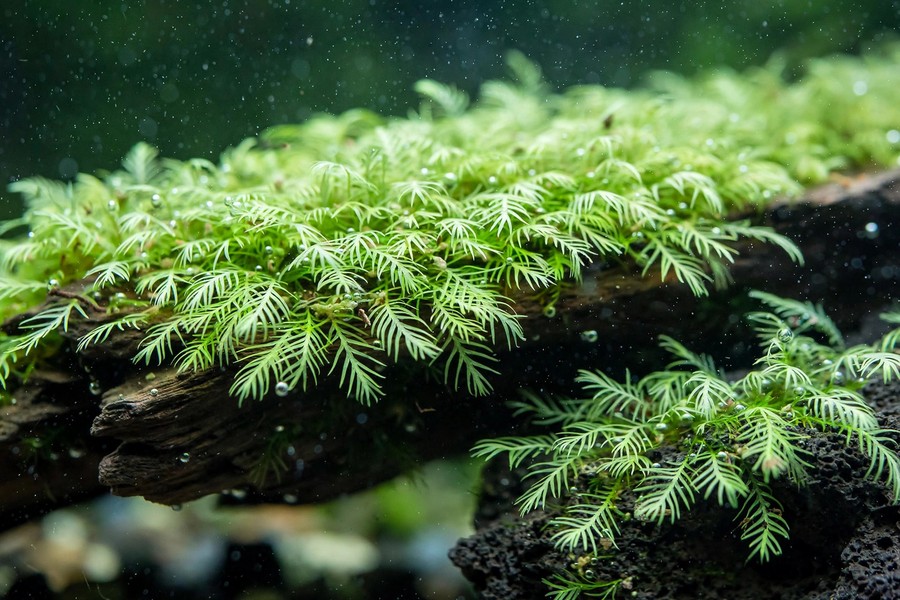
If Java moss always turns into a tangled mess in your tank, meet Fissidens. These two mosses — Fontanus and Nobilis — grow low and flat, spread gently over rock and wood, and never need the constant trimming other mosses demand. They look similar at a glance, but their fronds, colours and habits differ, and choosing between them comes down to the look you want.
Key takeaways
Fontanus is a very tiny frond, but a very, very pretty one. Its wispy, wavy ends recall the flowing tip of a peacock feather, and underwater that feathery movement is exactly what you see. It is a very easy plant to grow — in fact, very prolific — and it will most likely take over your aquarium, but not in a bad way: it will not kill or suffocate other plants.
What it will do is grow anywhere it can latch on. Throw it into one part of the tank, wait about six months, and you will find it popping up everywhere else, because detached fronds lodge somewhere new and start growing. Most mosses do this, but Fontanus is extremely good at it, turning up in the strangest spots. Its colour is a darker green, and its fronds hang over the surface they cover, giving a soft, draped look.
Nobilis looks a little smaller as a sheet — roughly a quarter inch smaller, largely because Fontanus has grown out to the edges while Nobilis is just touching them — but the real difference is the frond. Where Fontanus resembles a peacock feather, Nobilis recalls a fern: its leaves perk up like little feathers, but not peacock feathers, in a much brighter green.
Its fronds stick straight up or at an angle rather than curling over, yet the plant still stays short: only as tall as the fronds themselves, about a quarter of an inch. Like Fontanus, it spreads anywhere it gets lodged — a fish grazing a frond loose is enough to start a new patch somewhere else — so the two plants are almost identical in habit, with two different looks.
| Feature | Fissidens Fontanus | Fissidens Nobilis |
|---|---|---|
| Frond look | Wispy, wavy, like a peacock feather tip | Fern-like, perky feathers |
| Colour | Darker green | Much brighter green |
| Growth direction | Hangs over surfaces | Sticks straight up or at an angle |
| Height | Low and flat | About 1/4 inch tall |
| Availability | Common, often in local fish stores | Uncommon, rarely in big-box stores |
Unless you have a specific design in mind, keep Fissidens attached to the mesh it arrives on. The stainless steel mesh does several jobs at once: it keeps the moss anchored down, it means no glue or thread is needed, and it prevents the moss from floating away. You can literally just place it on a rock or a piece of driftwood, and the mesh can even be bent to fit logs or curves.
If you want smaller pieces, cut the mesh into sections with metal shears or strong scissors — a 3x3 square gives a decent amount of moss, and you can make little cubes if you like. That flexibility makes Fissidens easy to use on a CozyWoodLab driftwood centrepiece: bend a mesh section around a branch, tuck it into a crevice, and let the moss knit itself to the wood over time. Our driftwood bonsai guide shows how wood and moss together create the ancient-tree look these mosses suit best.
Here is the practical news: Fissidens does not need to be trimmed to stay short, and it does not get out of control like most mosses. It spreads low and flat instead of growing tall, gently covering surfaces like rocks and wood and growing into crevices. You are not going to wake up to a giant bushel of moss one morning — just a slowly widening carpet of tiny fronds.
That low habit is also what makes it such a good companion for other slow growers. Pair it with Bucephalandra on driftwood, for example, and you get two plants that both stay put, both tolerate low CO2, and both reward patience rather than demanding constant pruning.
Fontanus has been around for a while and may be available in a local fish store fairly easily — a common moss, though still not always easy to find. Nobilis is more of an uncommon moss: not quite rare, but you will not find it in most big-box stores, and you may need a specialist seller to get it.
Personally, the case for Fissidens over Java moss is simple. Java moss is often recommended because it is easy, but it keeps growing into a giant mess; Christmas moss has the same problem and needs constant trimming or grooming. Fissidens spreads naturally without becoming overwhelming, and that is a trade most aquascapers will happily make. Note that these are not the only two types of Fissidens — just the two most readily available — so if you catch the moss habit, there is more to explore. A moss-covered scape pairs beautifully with moving water, too, as our trickling-stream aquascape guide shows.
Tip: leave the mesh on. Beginners often peel moss off its mesh to glue it directly, then watch it float away in pieces — the mesh is the anchor, the handle and the shaping tool all in one, and the moss will grow over it until it disappears.