+

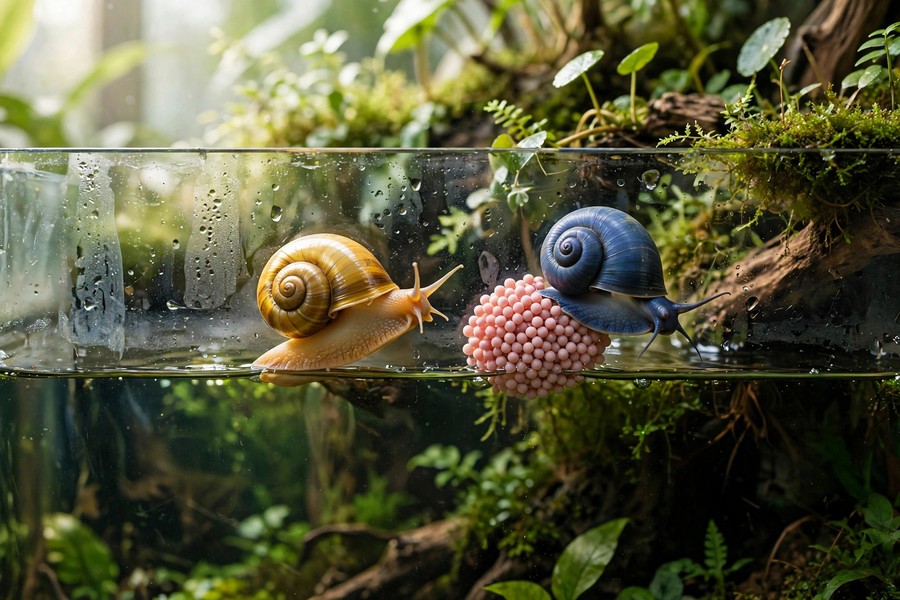
Mystery snails are peaceful, colourful and surprisingly charming — so it is no wonder many keepers want more of them. The good news is that breeding mystery snails is straightforward: you need a male and a female, a tank with room to grow, and one unusual detail — the eggs are laid out of the water. Here is the whole process, from pairing to raising a hundred tiny snails.
Key takeaways
Start with five or six snails in a tank of 20 gallons or above, especially for breeding. A larger tank is not about luxury — a big group of snails produces a fair amount of waste, and water quality problems are much easier to manage in more water.
Fit a nice tight-fitting lid, and lower the water level at least an inch or two below the top of the tank. The lid matters because the eggs are always laid out of the water, above the waterline — yet they also need to stay moist.
That moist air pocket is created by the combination of water in the tank and a sealed lid: humidity builds up in the gap, keeping the egg clutch damp without submerging it. A loose or missing lid is the most common reason a clutch dries out and fails.
A mystery snail clutch is a pale, cocoon-like mass stuck above the waterline, and it can be surprisingly large. One clutch can produce a hundred babies, sometimes more, which is far more than most keepers expect from a single snail.
There is nothing special you need to do for the babies once they hatch. They simply start doing what the adults do: eating algae, detritus, dead leaves and uneaten fish food around the tank.
That appetite is good news, but it also means you will need to step up feeding as the colony grows. A tank with a hundred growing snails puts real pressure on the ecosystem, so plan for more food and more frequent checks — much like the routine in our dip-and-quarantine guide for new plants and snails, which keeps hitchhikers and pests out of the tank in the first place.
| Stage | What happens | What you do |
|---|---|---|
| Pairing | Males and females mate in the tank | Keep 5–6 snails so both sexes are present |
| Egg laying | Clutch laid above the waterline | Keep the lid tight and the air humid |
| Hatching | 100+ babies drop into the water | Feed more; they eat algae, detritus and leftovers |
| Growing out | Shells grow fast and demand calcium | Supplement calcium and watch shell condition |
When a hundred snails are all growing at once, calcium demand rises sharply. Keep an eye on calcium levels in the tank, and consider calcium-rich snail foods or supplements so every shell can harden properly.
Shell problems are your early warning system. If shells start flaking, or show white patches, thin areas or pitting, the cause is usually too little calcium in the water or diet, or a pH that has dropped too low. Fixing water parameters early saves a whole generation of shells.
A mystery snail that has not moved for more than a day in the same position deserves a quick check. Lift it out and smell it: a dead snail smells very bad, very quickly, while a live one that is simply resting will not.
If it does not smell, put it back and keep watching. If it really is not moving around, something may be wrong — perhaps it is not getting enough food, or the water parameters need attention. Mystery snails generally live around a year, so a snail near that age may simply be reaching the end of its life.
Most snail-keeping problems come back to water parameters: nitrogen compounds in check, pH high enough for shell health, and water hardness correct. Get those three right and mystery snails are remarkably trouble-free.
They are peaceful, colourful and look lovely in a planted tank — and a natural driftwood and moss scape from CozyWoodLab gives a growing snail colony the surfaces to graze, the shade to rest in, and a home worth showing off. Pair that with a steady low-effort maintenance routine, and a snail colony practically looks after itself.
Tip: if a snail has sat still for over a day, do the sniff test before assuming the worst. Mystery snails rest for long stretches, and removing a healthy snail by mistake is a far more common error than missing a dead one.