+

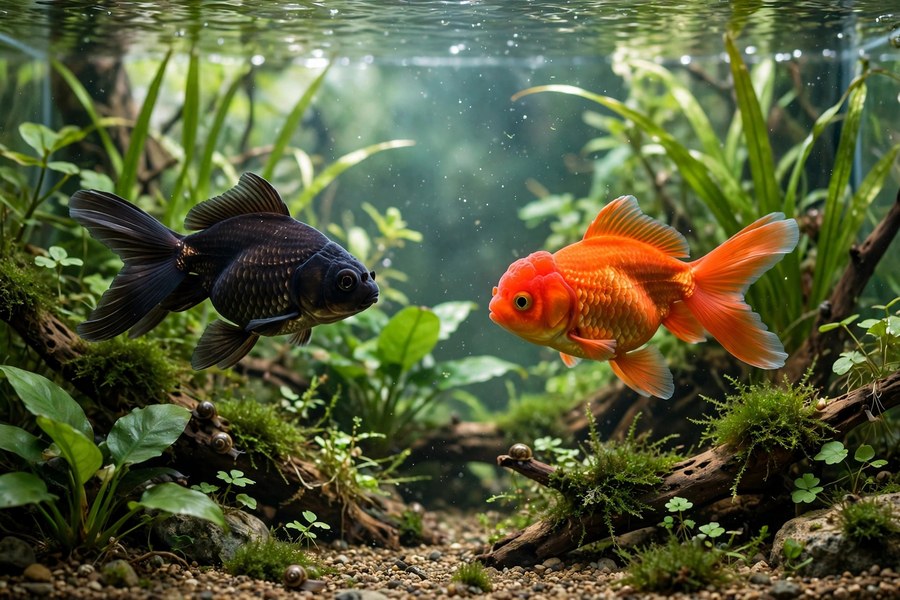
You bought a black goldfish. A few months later it is orange. Nobody swapped your fish — goldfish are simply one of the few pets that can change colour in front of you, and most of the time that change is a sign of normal growth, not illness. Knowing which changes are ordinary and which are warnings saves a lot of needless worry.
Key takeaways
A goldfish's skin holds pigment cells that produce melanin (black), red pigments, and yellow pigments. Those cells are not fixed in place: as the fish grows, pigment is redistributed, and the environment nudges the balance one way or another. The source sums it up neatly — genes decide what colours are possible, and the environment decides which one you see today.
| Stage | Age | What you see |
|---|---|---|
| Juvenile camouflage | 0–2 months | Olive-green or grey-brown, like a wild carp |
| Key colour change ('shedding') | 3–6 months | Grey fades and genetic colours — red, white, black — emerge |
| Colour peak | 6 months–2 years | Richest saturation, crisp colour-block edges |
| Senior fading | 3–5 years and older | Pigment cells age; black may turn red, red may turn white |
If you want a fish whose colour is already settled, the practical tip is to buy an adult that has passed the 3–6 month change. Even then, small shifts can still happen when the environment changes — that is normal, not a defect.
| Factor | How it changes colour | What to do |
|---|---|---|
| Light | UV in sunlight stimulates pigment production; dim indoor tanks fade colours | Give 8–10 hours of full-spectrum LED light daily |
| Background colour | Goldfish mimic their surroundings: pale backgrounds wash them out, dark ones deepen colour | Use a dark background if rich colour matters to you |
| Water quality and temperature swings | Stress degrades pigment | Keep water stable; avoid large, sudden water changes |
| Diet | Lack of carotenoids and astaxanthin fades red fish toward orange or yellow | Feed foods rich in spirulina, astaxanthin, or carotenoids |
Almost. No variety can promise a lifetime of unchanged colour — only the speed and size of the change differ. The most common paths are black turning red or orange, red fading to white with age or stress, and grey juveniles maturing into gold.
Black is the least stable of all goldfish colours, and once it fades it almost never returns. A black fish that stays black has usually combined good genetics, a high 'change threshold', and a stable environment — which is why experienced keepers say choosing the fish matters more than raising it.
They strengthen the pigments a fish already has; they cannot rewrite its genes. A red fish on astaxanthin-rich food with stable water and good light will look noticeably richer, while the same food cannot turn a genetically white fish red.
Slow, even change over weeks or months is normal. Sudden, large-area whitening is not: the source flags parasites such as fish lice or white spot disease, whose mucus and lesions can mask colour, as a first thing to check. Stress from unstable water is the other usual suspect.
Tip: Keep goldfish water slightly alkaline (pH 7.2–7.8) and stable above all else. Frequent big water changes and sharp temperature swings are the fastest way to wash colour out of an otherwise healthy fish.
If a fish is also behaving oddly — hiding, gasping, or lying still at night — compare that behaviour against how to tell sleeping from sickness and check the other health clues in what fish waste reveals about health. Colour alone rarely diagnoses anything; colour plus behaviour usually does.
Colour change, seen properly, is something to enjoy rather than fight. A goldfish that shifts from black to gold in your care is not broken — it is growing up in front of you. At CozyWoodLab we think that is part of the charm: the fish you bought is rarely the fish you end up with, and the healthy, active, steady-coloured fish is the beautiful one, whatever shade it settles on.