+

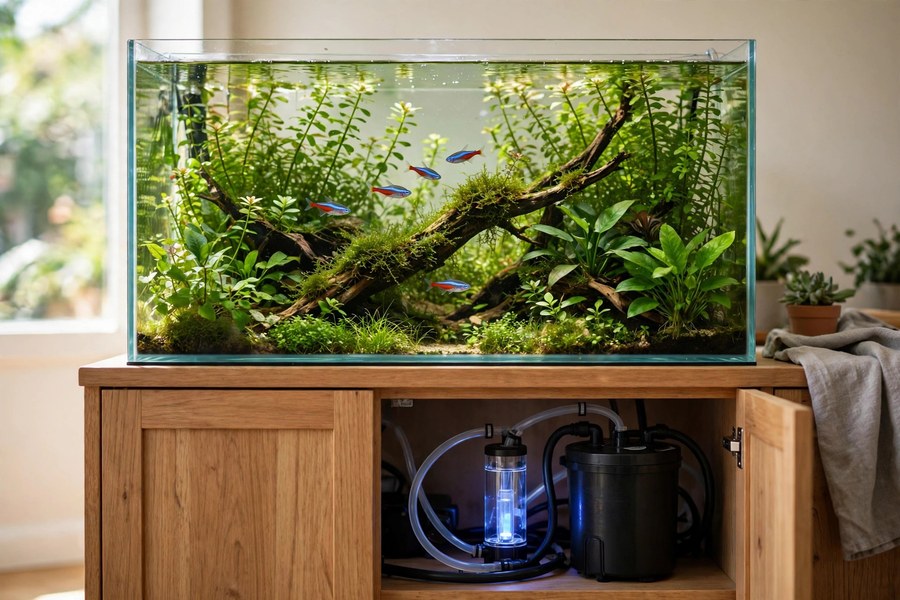
Green water overnight, a milky haze that will not clear, fish falling ill one after another — sooner or later most keepers hear about the same gadget: the aquarium UV sterilizer. It has a reputation as both a miracle cure and a waste of money, and the truth sits in between. Used in the right place, it is a genuinely useful tool; used blindly, it can do real harm.
Key takeaways
Inside the unit, water flows past a UV-C lamp. The ultraviolet light breaks down the DNA of bacteria, viruses, and free-floating algae spores in that stream of water, leaving them unable to multiply. The treated water then flows back into the tank, usually through the biological filter, which finishes the job.
The key limit is right there in the design: only the water that passes through the lamp gets treated. A sterilizer is more like a checkpoint on a road than a medicine dissolved through the whole tank, and that single fact explains both its strengths and its limits.
| Problem | What UV does | What to expect |
|---|---|---|
| Green water (floating algae bloom) | Damages algae spores passing through the lamp | Water usually clears gradually over a few days |
| Milky bacterial bloom | Reduces free-floating bacteria | Haze fades as the bacterial population drops |
| High pathogen load | Lowers the density of waterborne pathogens | Lower infection pressure, especially in dense or breeding tanks |
| General clarity | Removes suspended microbes and algae | Visibly clearer water |
That last row matters for planted tanks too: clearer water lets light reach your plants properly, which is one reason a sterilizer often gets recommended alongside algae control. For a full picture of algae types and their root causes, see how to identify your algae type before treating it.
A sterilizer will not scrub algae off glass, rocks, or driftwood, because that algae never flows through the lamp. It will not remove bacteria living in the substrate, and it will not cure a fish that is already sick. It is also no substitute for filtration, sensible stocking, or regular water changes — the source guide puts it bluntly: filtration should always matter more than sterilisation.
This is the question nearly every beginner asks, and the answer is reassuring. The nitrifying bacteria that run your nitrogen cycle live attached to filter media, gravel, and surfaces, not drifting in open water. Because the lamp only treats passing water, a correctly installed unit has very little effect on the colony.
If your cycle is still establishing, read how to cycle a planted aquarium the patient way first — a new tank needs its bacteria far more than it needs a sterilizer.
| Type | How it installs | Best for |
|---|---|---|
| Inline / external unit | Plumbs into canister-filter tubing | Medium and large tanks; most stable performance |
| Submersible unit | Sits inside the tank, shielded | Small tanks; simple to install |
| Built into a filter | UV lamp inside the filter body | Saving space; filtration and sterilising in one box |
UV-C does not distinguish between a pathogen and a fish. Direct exposure damages skin, gills, and eyes, and a lamp dropped unshielded into a tank has killed fish overnight. The same light burns human eyes and skin, so never look at a bare lamp or run one with the cabinet door open.
Tip: Run the unit only in a light-tight housing or opaque tubing, keep it away from filter media chambers, and aim for a flow rate that turns the whole tank over roughly every 20 minutes. If water quality worsens after switching it on, turn it off and re-seed beneficial bacteria rather than pushing on.
Two more practical habits complete the picture. Replace the lamp every 6–12 months even if it still glows, because UV output fades long before visible light does. And treat sterilising as a short-term response to green or cloudy water, not a permanent crutch — a healthy, stable tank does not need constant disinfection.
| Your situation | Verdict |
|---|---|
| Stable water, good filtration, no green or cloudy water | You do not need one |
| Recurring green water or bacterial blooms | Worth trying, alongside fixing light and nutrients |
| High stocking density, breeding tanks, or sensitive species | A sensible precaution |
| Algae on glass or sick fish needing treatment | A sterilizer alone will not solve it |
Pair the decision with the basics that actually keep water clear: condition new water properly (what each water conditioner really does), keep flow gentle and well distributed, and watch for early warning signs like unusual surface bubbles.
A UV sterilizer is a helper, not a miracle. At CozyWoodLab we love gear that solves a specific problem well — and this one earns its place exactly when green water, cloudy water, or a crowded tank calls for it, and stays in the cupboard when the tank is already healthy.