+

You spent an evening picking the perfect stems and floaters, clicked pay — and a red error appeared: 'This item cannot be shipped to your location.' Or worse, half your order was cancelled a day later. It feels like a website bug, but it is usually the law: some of the hobby's favourite plants are legally restricted in some places because they are invasive species.
Key takeaways
The traits that make a plant great in a tank are exactly the traits that make it dangerous outdoors. It grows fast, reproduces from tiny broken fragments, and survives a wide range of water conditions. If a fragment escapes — someone empties a tank into a drain, or trimmings wash into a storm drain — it can multiply out of control.
Species like Cabomba, Brazilian elodea (sold as Anacharis), Water Lettuce, and Salvinia can form thick floating mats that block sunlight, strip oxygen from the water, and choke out native fish and wildlife. The restriction is not a judgement on your tank; it is protection for the waterway downstream of it.
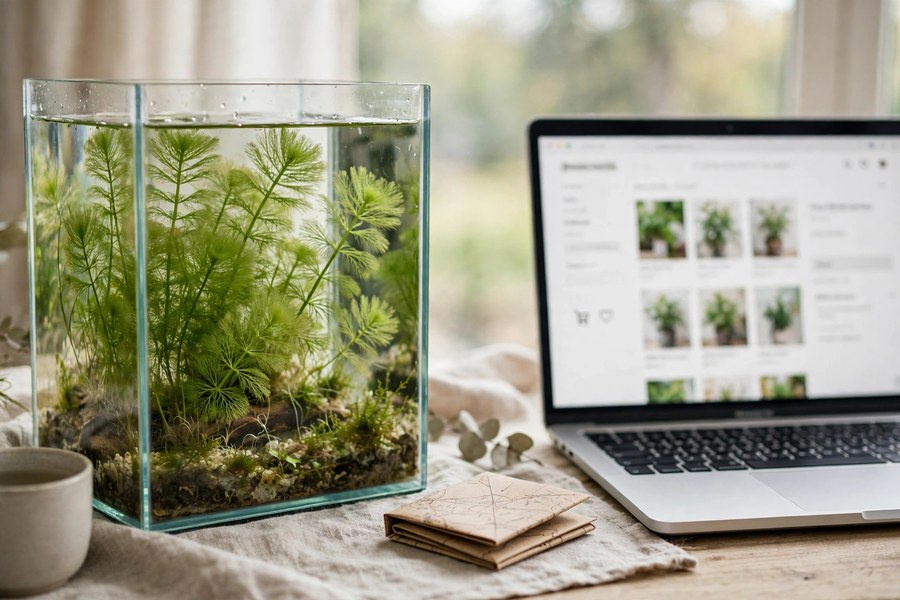
Take Green Cabomba (Cabomba caroliniana), a feathery stem plant that aquascapers love for soft, dense underwater forests. Its legal status changes dramatically across state lines, and individual vendors apply their own compliance checks on top of the law — which is why one shop ships it freely while another blocks the same order.
| Where Green Cabomba is restricted | Basis |
|---|---|
| Michigan | State-listed as a prohibited species |
| Wisconsin | State DNR lists it as invasive and regulated |
| Washington | Commonly restricted by state regulation and vendor policy |
Treat that table as a snapshot, not a guarantee: state rules change, and enforcement varies by vendor. Always verify directly with your state's Department of Natural Resources or Department of Agriculture before ordering, and remember that federal noxious-weed lists from the USDA sit underneath state bans rather than replacing them.
It is tempting to think a sterile, lab-grown tissue-culture cup should be exempt — it arrives pest-free and clean. Usually it is not exempt, because the law targets the species itself, not the propagation method. A tissue-culture Cabomba is still Cabomba once it grows out in your tank.
If you are new to plant shopping, the quarantine habit matters just as much as the legal one: new plants can carry hitchhikers, so follow the dip-and-quarantine routine for new plants before anything goes into your display tank.
Invasiveness risk depends on local climate and waterways. A plant that cannot survive a cold northern winter outdoors poses far less risk there than in a warmer region where it could establish year-round. Possession is usually not the issue either — most state laws target sale, transport, and intentional release — but the details vary, so check your own state's rules if you are unsure.
This is the part every keeper controls directly. Never flush unwanted plants down the toilet, and never toss them into a backyard pond or local waterway. Seal trimmings in a plastic bag, freeze them overnight to kill the tissue, and throw them in the trash. Thirty seconds of care keeps the hobby open and accessible for everyone.
Tip: When a plant you want is restricted where you live, ask the vendor for a legal substitute with a similar look. Feathery stems, floating cover, and fine-leaf texture all have unrestricted alternatives — start with proven easy growers like those in our guides to plants that thrive without CO₂ and Bucephalandra tissue-culture care.
Checking the rules before you order is a small habit with an outsized payoff: no cancelled carts, no wasted evenings, and no risk to the rivers and lakes near your home. At CozyWoodLab we would rather see a tank planted with a legal plant you love than a perfect scape that never legally arrives.