+

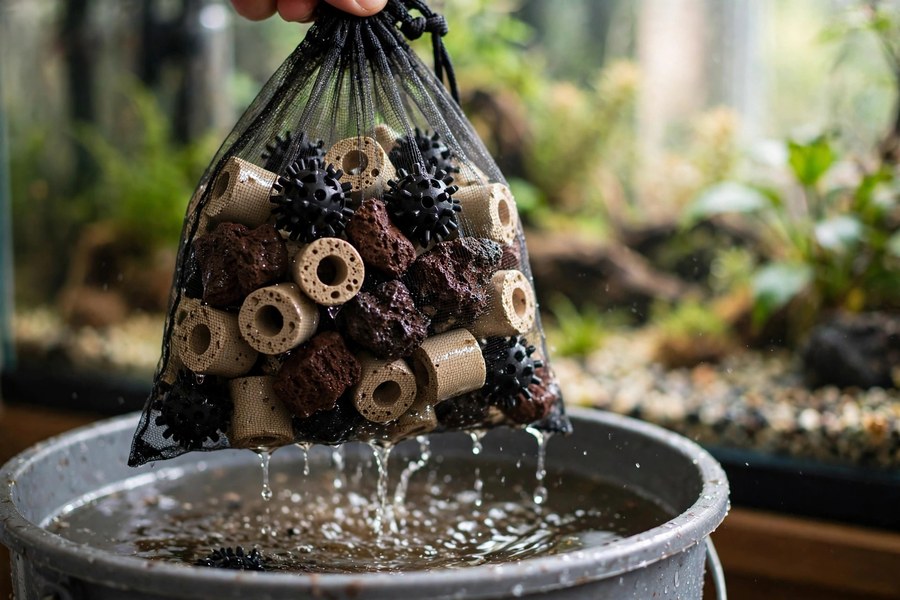
Most beginners assume the humming box on the back of the tank is a cleaning machine: plug it in, water flows through, waste disappears. The real cleaning crew is invisible. It is the colony of beneficial bacteria living inside your filter media — and bio balls are simply the apartment block built to house them.
Key takeaways
To the naked eye, a mixed bio-media blend looks like colourful gravel. Under magnification it is riddled with tiny pores — a high-density housing estate for nitrifying bacteria. The blend in the source guide packs more than ten media types into one mix, including porous ceramic rings, mineral cubes, lava rock, and bio spheres.
Once colonised, those bacteria become the engine of the tank, quietly running the nitrogen cycle: ammonia from fish waste becomes nitrite, then nitrate, which is far safer and is removed by water changes and plants. It is the same fix pointed to whenever ammonia shows up unexpectedly — biological filtration is almost always the missing piece.
If your tank is new, start with how to cycle a planted aquarium the patient way: bacteria need weeks to colonise new media, and no media works before its tenants move in.
The fastest way to crash a tank is also the most well-meaning. You pull out the filter media, notice it looks brown and slimy, and scrub it clean under the kitchen tap. Tap water contains chlorine and chloramine, which instantly kill the bacterial colony. A dead colony means an ammonia spike — and the 'cleaning' becomes the disaster.
| Do | Don't |
|---|---|
| Swish the mesh bag gently in a bucket of old tank water during a water change | Scrub media under tap water |
| Clean only when flow visibly slows | Clean on a fixed schedule or polish media spotless |
| Keep media wet and in the filter flow | Let it dry out or sit in stagnant water |
Order in the filter matters more than most people realise. Mechanical filtration — a sponge or floss pad — must come first in the flow path so it catches physical debris before it reaches and clogs the microscopic pores your bacteria live in. Biological media sits behind it, bathed in clean, oxygen-rich flow.
| Position in flow | Media | Job |
|---|---|---|
| First | Sponge or filter floss | Catches debris so bio pores stay open |
| Second | Bio balls / ceramic / lava rock blend | Houses nitrifying bacteria |
| Last (optional) | Chemical media such as carbon | Polishes water; replace on schedule, unlike bio media |
It depends on your filter's media basket, not on a universal weight: a nano or internal filter needs less volume than a canister or hang-on-back. Fill the basket sensibly without packing it so tight that flow is choked.
Ideally yes, because flowing water pushes oxygen to the bacteria. In an emergency hospital-tank setup, hanging the mesh bag directly in the water near an airstone or powerhead keeps the colony alive temporarily — a useful stopgap, not a permanent home.
Mixed mineral media can nudge pH and GH upward slightly over time. That is a non-issue for most community tanks, but worth monitoring in soft-water shrimp setups — and if leaves are yellowing for other reasons, check what yellow leaves are telling you about nutrients before blaming the media.
Tip: Disturb bio media less, not more. If flow is fine, leave it alone — a brown, slimy-looking bag is usually a healthy, working colony, not a dirty one. And when you do rinse it, always use removed tank water, never tap water, so the bacteria survive the wash.
Good biological filtration underpins everything else in the tank, from safe water changes (what each water conditioner really does) to reading early trouble signs such as unusual surface bubbles. Put a bag of mixed media in the filter, leave it alone, and let nature do the heavy lifting — at CozyWoodLab, that quiet, boring reliability is exactly what a good aquascape is built on.