+

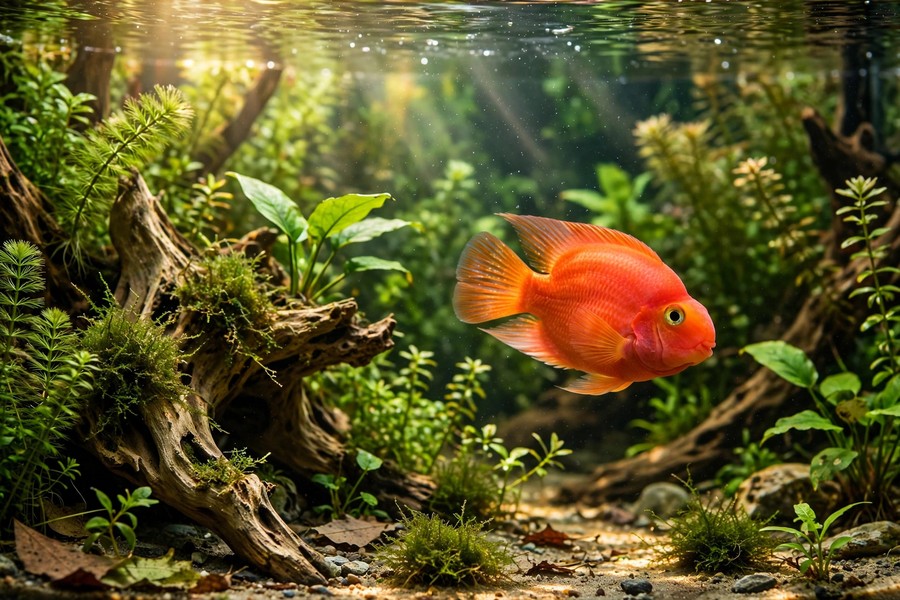
With their round bodies, bright red colour, and almost smiling mouths, blood parrot cichlids are some of the most recognisable fish in the hobby. They are friendly, interactive, and full of personality — but because they are a human-made hybrid, they also come with a few quirks that new keepers should understand before bringing one home.
Key takeaways
The blood parrot, also sold as the red parrot or fortune fish, was developed in Taiwan in the late 1980s by crossing the orange midas cichlid (often called the red devil) with the redhead cichlid. It does not exist in the wild. The result is a deep-bodied, brightly coloured fish with a small, beak-like mouth that gives it its parrot look and its permanent little smile.
Young fish start out pale or striped and colour up to red or orange-red as they mature. Colour-enhancing foods rich in astaxanthin can deepen the red, but the base colour is genetic — no food will turn a pale fish crimson overnight, and dyed fish sold in some shops should be avoided, since the dyeing process harms their health.
Selective breeding has produced several distinct lines from the classic blood parrot. They share the same basic care, but differ in size, shape, and swimming ability.
| Variety | How it differs | Keeper notes |
|---|---|---|
| Classic blood parrot | Round body, red-orange, beak-like mouth | The standard; easiest to find |
| King Kong parrot | Larger, thicker body, mouth closes better | Eats more easily, needs a bigger tank |
| Yuanbao (ingot) parrot | Extra-round, ingot-like shape | Very ornamental but a weaker swimmer |
| Love Heart parrot | Tail trimmed into a heart shape | A man-made trim, not a natural form |
| Kirin parrot | Blood parrot × flowerhorn cross, patterned with metallic sheen | Showier, often pricier |
| Albino, pink, and spotted lines | Further selective colour breeding | Same care; avoid dyed individuals |
Blood parrots are not especially hard to keep, but they demand stability. Set the tank up properly once, and avoid frequent rearrangements that stress them. A single adult needs at least a 60 cm tank; a group or a community setup is far more comfortable in a 90 cm tank, where the extra water volume also dilutes waste.
Keep temperature at 24–28°C and pH around 6.5–7.5, but remember that steady water beats textbook-perfect water. High-porosity filter media such as ceramic rings gives beneficial bacteria plenty of surface area, which matters because blood parrots are messy eaters with a heavy bioload. If you are still choosing a tank, our guide to choosing the right aquarium size and material covers the volume-versus-stability trade-off.
That cute mouth is the main feeding challenge: blood parrots cannot grab and crush food as efficiently as other cichlids. Choose small, easy-to-swallow floating pellets as the staple, and supplement with bloodworms or shrimp for variety. Feed little and often — once or twice a day, only what they finish in about two minutes — because uneaten food quickly fouls the water.
For colour, a quality colour-enhancing pellet with astaxanthin helps maintain a rich red. Use it as part of the diet, not the whole diet, since overfeeding rich foods can strain the liver over time.
| Pros | Cons |
|---|---|
| Striking looks and strong presence in the tank | Mouth shape limits feeding efficiency |
| Gentle for a cichlid; often community-friendly | Large adult size needs a big tank |
| Highly interactive — many learn to recognise their keeper | Heavy waste output means more water management |
Blood parrots can share a tank, but choose companions of similar size and calm temperament — angelfish and medium-sized tetras are common picks, and our angelfish care guide explains what those tank mates need. Avoid very small fish, which may be chased or accidentally eaten, and avoid aggressive species that will bully a parrot that cannot defend itself well.
Day to day, watch four things: sudden water changes (keep changes gradual), whether every fish is actually getting food at mealtimes, overcrowding, and any fading colour or unusual behaviour, which is often the first sign that water quality has slipped.
Tip: if one parrot always loses at feeding time, feed at two spots in the tank at once. The dominant fish cannot guard both, and the shy one finally gets its share.
Blood parrots are not difficult fish — they are simply fish with a short list of non-negotiables: stable water, enough room, food they can actually eat, and tank mates that will not bully them. Get those right and they repay you with years of colour and character. That is the CozyWoodLab approach in a nutshell: match the setup to the animal, and the beauty takes care of itself.