+

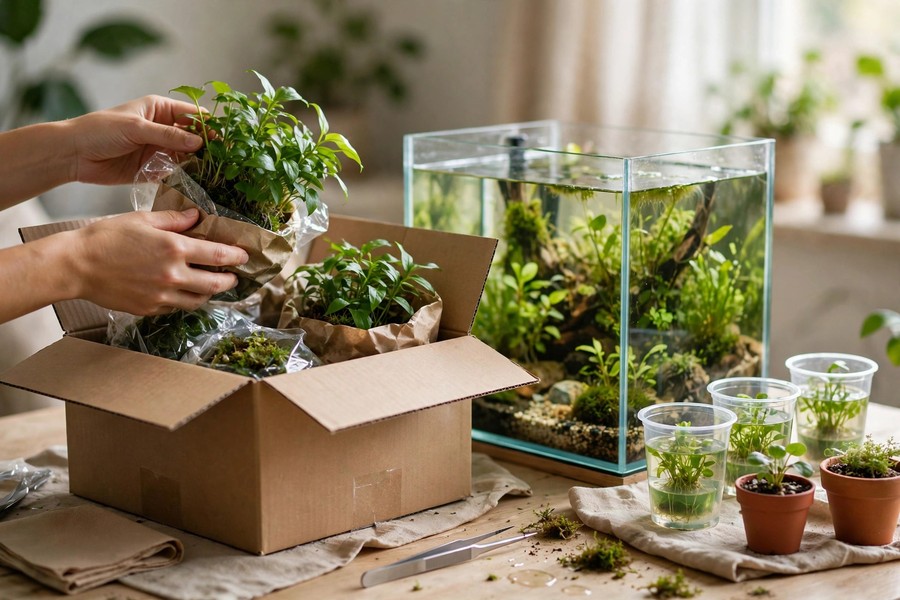
Ordering live aquarium plants online is exciting — until unpredictable weather turns delivery into a gamble. Even good sellers using heat packs or ice packs cannot control a delayed parcel in extreme heat or cold. The good news: get the first hour after delivery right, and even plants that travelled through rough weather usually recover fully.
Key takeaways
The single biggest mistake in plant deliveries is leaving a parcel sitting in a mailbox or on a porch for hours. Track the shipment and plan to be home when it lands. In extreme heat or freezing cold, an uninsulated mailbox quickly becomes an oven or a freezer — bring the box into a climate-controlled room the instant it is delivered, even before opening it.
Never shock new arrivals. Plants that arrive freezing must not go into warm water, and heat-stressed plants must not be plunged into cold water. Thermal shock damages cell structure faster than transit stress itself, so the correction always has to be gradual, in either direction.
| Scenario | What happened | What to do |
|---|---|---|
| Winter delivery, heat pack expired | Plants arrive freezing | Never place into warm water — sit at room temperature for 1–2 hours |
| Summer delivery, ice pack melted | Plants arrive hot and stressed | Do not shock with cold water — float in room-temperature water under a fan or in air conditioning |
Once plants reach room temperature, prep them according to how they were grown and packed. Each type has one job that matters most.
| Plant type | Prep step | Why it matters |
|---|---|---|
| Potted plants | Remove from the pot; pick rockwool from roots under slow-running water with fine tweezers | Rockwool left on rots and tears roots if pulled dry |
| Bunched or stem plants | Remove sponge, weight, or rubber band; snip 1/4 inch off each stem bottom | A fresh cut stimulates fast new root growth |
| Tissue-culture plants | Wash nutrient gel away under lukewarm water | Leftover gel quickly triggers fungal blooms and algae |
| All types | Trim dead or translucent foliage immediately | Rotting matter in the tank causes an ammonia spike |
Dipping is a real biosecurity step, not an optional extra: it stops pest snails, parasites, and nuisance algae from entering a balanced tank. Mix 1 to 3 tablespoons of alum (aluminium sulfate) per gallon of water, submerge the plants for 1–2 hours, then rinse extremely well with dechlorinated water. It is highly effective against snails and eggs, and safe for the plants themselves.
Avoid bleach dips, especially for sensitive species and delicate mosses — bleach easily burns and melts foliage that an alum dip would leave unharmed. For the full routine, see our guide to the dip-and-quarantine routine for new plants.
Now it is time to plant — but be ready for melting. Most nursery plants grow emersed, above water, and when submerged they shed those leaves to grow new submerged foliage adapted to aquatic life. This is completely normal, especially for Cryptocoryne. Trim melting leaves promptly, and as long as roots and rhizomes stay healthy, new growth appears within a few weeks.
For the first week, cut LED lighting to about 6–7 hours a day and halve liquid fertilizer dosing. That lowers algae risk while plants are at their most vulnerable. Once new growth appears, raise both back to normal gradually. If leaves keep yellowing after settling in, our guide to yellow aquarium plant leaves helps separate deficiency from transition stress.
Tip: photograph frozen or wilted arrivals before you start fixing them. If a plant does not recover, that photo is what the seller needs for a DOA claim — most sellers ask for documentation within 12 hours of delivery.
| Question | Answer |
|---|---|
| What if plants arrive frozen or wilted? | Do not rush the fix. Bring them to room temperature gradually over 1–2 hours first; most recover fully. |
| Do I need to quarantine even from a trusted seller? | Yes. Pest eggs and hitchhiking snails survive careful shipping; an alum dip takes under two hours. |
| Is melting after planting always normal? | In new arrivals, almost always — transition stress, not a dying plant. Trim and wait a few weeks. |
A rough delivery is not a lost plant. Bring it in fast, acclimate slowly, clean and dip before planting, and give the first week a gentle light and feeding regime. Handle the arrival right, and even a plant with a rough trip settles into a thriving addition — which, at CozyWoodLab, is exactly how we like new greenery to meet a driftwood scape: healthy, clean, and ready to grow.