+

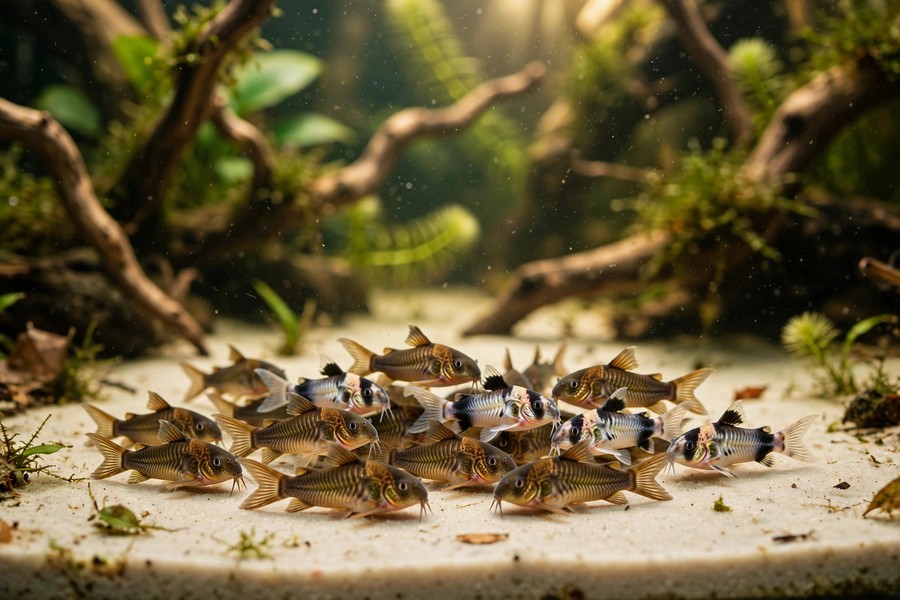
If you want a peaceful beginner fish with real personality, cory catfish are hard to beat. These cheerful South American bottom dwellers shoal together, sift the substrate with their whiskers, and quietly tidy up leftover food. This guide covers what they are, the tank they need, what to feed them, and how easily they breed.
Key takeaways
Corydoras are a genus of South American catfish named for the bony plates of armour covering their bodies. More than 160 species are described, with several hundred more still awaiting classification, and most aquarium species grow to just 1–3 inches.
For protection they carry sharp spines in their fins, which can deliver a mild venom when the fish is stressed. That is one more reason never to catch them with bare hands. In the wild they gather in groups of 20 to hundreds of the same species, and they are most active during the day, peaking at dawn and dusk.
Popular varieties include the bronze and albino cory (Corydoras aeneus), panda cory (Corydoras panda), emerald green cory (Corydoras splendens) and the tiny pygmy cory (Corydoras pygmaeus). Pygmy corys are unusual in that they often swim in midwater, not just along the bottom.
Dwarf species may suit a 10-gallon aquarium, but 20 gallons or more is the better recommendation for most varieties. A group of six or more of the same species is strongly suggested, since safety in numbers is what lets corys relax and show their natural behaviour.
They are peaceful enough for almost any community tank, provided their tankmates will not eat or attack them. Goldfish are a poor match: they grow large and will inhale anything that fits in their mouths.
A classic 20-gallon community stacks three layers: corys on the bottom, a school of small tetras in the middle, and a centrepiece such as a honey gourami above. Add lush plants and driftwood, and you have a miniature ecosystem — which is why cycling a planted tank properly before stocking matters so much.
| Popular variety | Size and character | Good to know |
|---|---|---|
| Bronze / albino cory (C. aeneus) | Around 2–3 inches; hardy and outgoing | The classic beginner cory |
| Panda cory (C. panda) | Smaller and shy at first; striking markings | Prefers cooler water within the cory range |
| Pygmy cory (C. pygmaeus) | About 1 inch; swims midwater in a shoal | Best in a calm, well-planted tank |
| Sterbai cory (C. sterbai) | Bold pattern; tolerates warmer water | A good match for warm-water communities |
Corys find food with wispy barbels, or whiskers, so smooth sand or smooth gravel is preferred. Larger foods such as worms and gel foods sit on top of the substrate where corys can reach them, instead of falling into cracks.
Interestingly, wild corys have been found living over quite sharp substrate in the Amazon. If barbels start to erode in your tank, poor water quality is a more likely culprit than the gravel itself — keep the substrate clean and the water stable.
Corys are not picky, and they will eat anything small or soft enough to fit in their mouths. They love worms of all kinds: live blackworms, frozen bloodworms, and tiny worm-shaped food sticks are all eagerly taken.
They also enjoy gel foods, sinking wafers and other sinking community foods. The key point is that they are not primarily algae eaters, so you must feed them deliberately — in a tank with aggressive eaters, corys can easily be outcompeted and slowly waste away.
Watch at feeding time to make sure food actually reaches the bottom. A simple low-effort maintenance routine that includes regular substrate cleaning keeps both the corys and the tank healthier.
Yes, very easily — many keepers find their corys spawning on their own with no special effort. Males are smaller and slimmer, while females are rounder and larger to carry eggs.
To condition a group, feed plenty of nutritious foods such as live blackworms and frozen bloodworms. Then imitate the rainy season with a water change a few degrees cooler than the tank, and you will soon find sticky round eggs on the glass and decor.
If you breed them in the community tank, give the eggs cover — a dense mass of java fern or guppy grass helps — and remember that all fish, including the parents, will happily eat eggs. For a higher survival rate, roll the eggs off with your fingers or a credit card into a separate tank, and feed the fry live baby brine shrimp and powdered fry food with frequent small water changes.
A calm, well-scaped tank makes all of this easier to enjoy, and a natural driftwood hardscape from CozyWoodLab gives corys the shaded corners and grazing surfaces they love while they go about their cheerful bottom-dwelling business.
Tip: never net a cory by scooping roughly, and never handle one with bare hands. Their fin spines can prick, and a stressed cory is a cory that stops eating — use a soft net and move slowly.