+

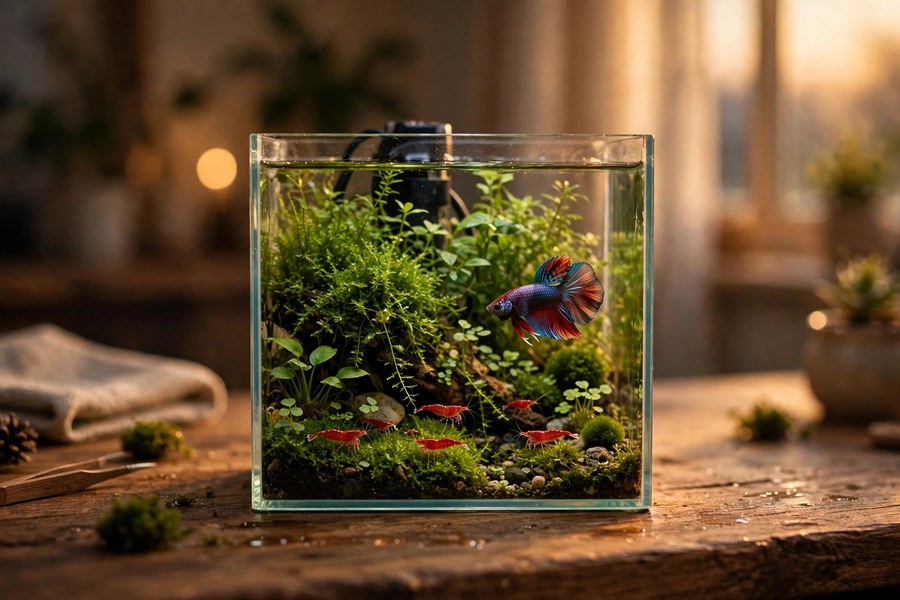
You have just built the perfect desktop tank: a sleek glass cube beside your keyboard, soft moss, a twist of spider wood, cherry shrimp grazing in the light. Then evening comes, the house cools, the air conditioning kicks in — and the glass feels cold. Small tanks look effortless, but they hide one big weakness: with so little water, temperature follows the room, not the other way around. Unless your home holds a steady 78°F all year, almost every nano tank needs a heater.
Key takeaways
Temperature stability is a volume game. Twenty gallons of water absorbs a cold evening slowly; one gallon tracks the room almost immediately. That swing is a real shock for a betta or a dwarf shrimp colony, both of which evolved for warm, steady water. If your room temperature drops at night or your air conditioning runs hard, an unheated nano tank can drift far below the range its livestock tolerates — which is why choosing the right tank size and its heating go hand in hand.
A 5-gallon tank is easy: a compact 25W or 50W heater usually hides behind the filter without trouble. A true micro setup — a 1-gallon betta bowl or a tiny shrimp jar — is a different story. The smallest heater in most pet stores is still a long glass tube that wrecks a carefully built scape, and it is genuinely risky: a high-wattage element warms a tiny volume so aggressively that the thermostat cannot keep up, and the tank swings between too cold and dangerously hot.
The fix is a heater built for micro volumes. A 10W mini USB heater's quartz-glass probe is only about 5 cm — roughly two inches — long, so it vanishes behind one Anubias leaf or a piece of hardscape. Drawing just 10W from a standard USB port, it warms water gently instead of overshooting, which is exactly what a tiny volume needs. Its external in-line digital controller replaces unreadable dial knobs with a crisp LED readout accurate to about 1°F, so you always know the real temperature instead of guessing.
| Safety feature | What it does | Why it matters in a nano tank |
|---|---|---|
| Dry-run protection | Auto shuts off and shows 'E1' if the probe leaves the water; resumes once submerged | Nano tanks evaporate fast — a dropping waterline will not burn out the element |
| Overheat protection | Auto shuts off and shows 'H1' above 97°F | Caps the worst-case swing in a tiny volume |
| Digital thermostat (±1°F) | Holds temperature far tighter than knob heaters | Shrimp and bettas stress over swings of just a few degrees |
| USB powered (5V/2A) | No bulky transformer; runs from a wall adapter or power bank | Keeps the desktop setup clean and portable |
Top off regularly anyway. Dry-run protection saves the heater, but a heater that keeps shutting off is not heating your tank. Check the waterline every few days and top off before it triggers a shutdown. Keep the controller dry. The glass probe is submersible; the plastic control box with the display is not, so mount it safely outside the tank. Give it time to stabilise. A 10W element warms slowly by design — set it, walk away, and let it settle gradually rather than panicking after ten minutes.
Can I plug a USB heater into my computer? Technically yes, but PC USB ports can deliver inconsistent power — a dedicated 5V/2A wall adapter or power bank is safer. Is 10W enough for a 5-gallon tank? It depends on the unit: a micro heater rated for 1–2 gallons will not keep up with 5 gallons, while a slightly larger 10W-rated model built for up to about 6.6 gallons can — always check the rated capacity, not wattage alone. What temperature range can it hold? Roughly 64–93°F through the digital controller, covering most tropical fish and shrimp. Will a dropping water level damage it? Not with dry-run protection: it shuts off safely and resumes once submerged, though regular top-offs are still good practice.
Heating is only half of stability: water movement matters too, so pair this guide with how to judge aquarium water flow to make sure gentle circulation spreads the warmth evenly. And if your nano tank houses a betta, soft, safe plants for betta tanks will give it the cover it needs around that hidden heater. A well-chosen nano heater tucked behind a leaf, with a driftwood accent from CozyWoodLab to complete the scape, turns a pretty desktop jar into a genuinely stable little ecosystem.
Tip: place the heater near gentle water flow — beside the filter outlet — so warmed water circulates evenly instead of forming a warm pocket around the probe while the far side stays cold.