+

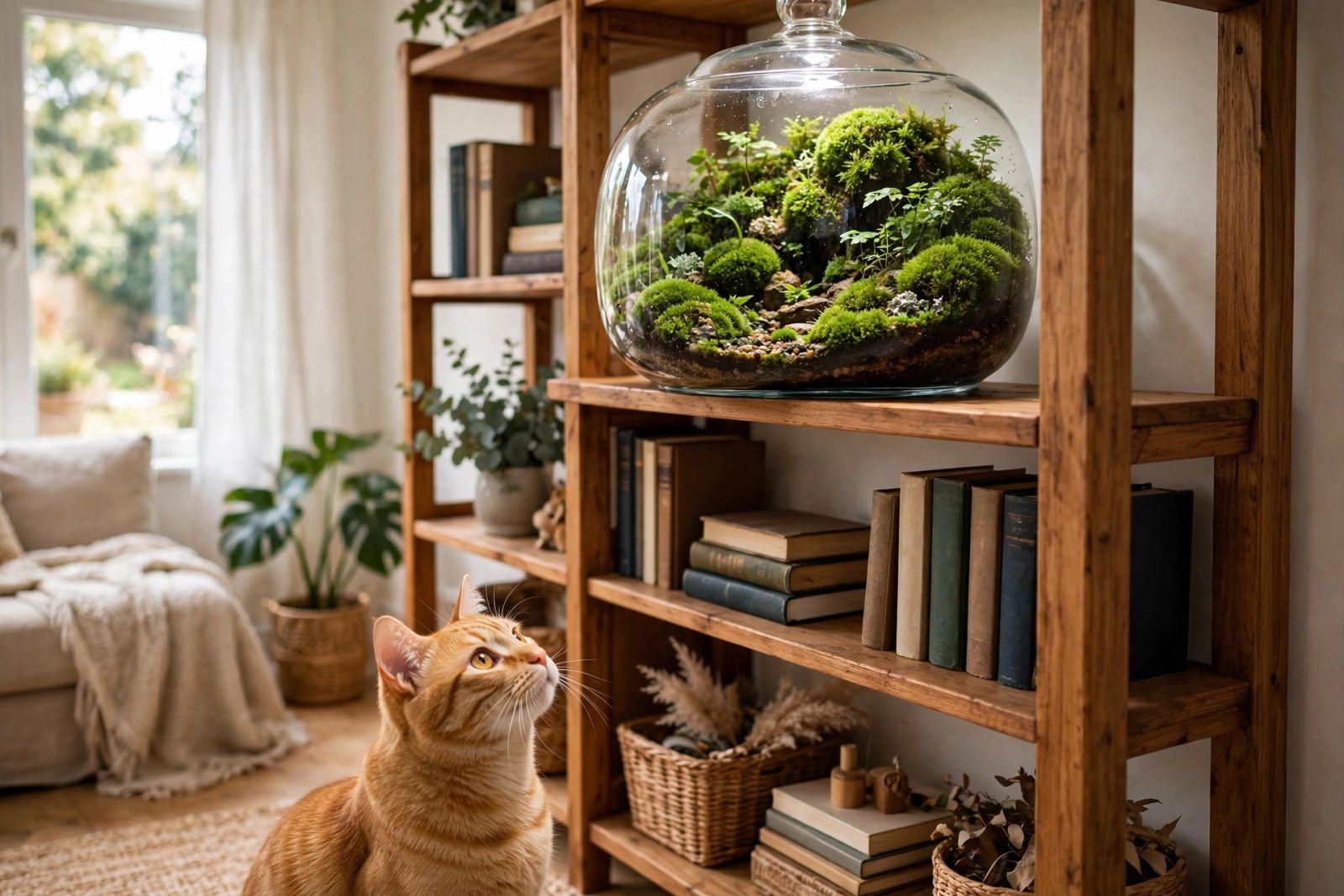
You are halfway through a work call when you spot it: the cat, up on the shelf, nose-deep in the terrarium you brought home last week. One paw is already testing the moss. And your brain does the same little lurch every pet owner knows — wait, is that stuff poisonous? Here is the good news first: true moss is one of the safest pieces of greenery you can keep in a pet household. The part that actually deserves your attention is everything around it.
You are halfway through a work call when you spot it: the cat, up on the shelf, nose-deep in the terrarium you brought home last week. One paw is already testing the moss. And your brain does the same little lurch every pet owner knows — wait, is that stuff poisonous?
Here is the good news first: true moss is one of the safest pieces of greenery you can keep in a pet household. The part that actually deserves your attention is everything around it.
Live moss is listed by the ASPCA as non-toxic to both cats and dogs, and so are the plants people commonly mistake for moss — club moss, cushion moss, Irish moss, and the Selaginella family. None of them carry compounds that poison pets or damage organs.
That does not make moss pet food. Any animal that wolfs down a big mouthful of plant matter can throw up simply from the volume and fibre. Non-toxic means it will not poison them, not that it belongs in their diet.
Not everything sold under the name moss is actually moss. Rock moss — also sold as moss rose or purslane (Portulaca oleracea) — is a flowering succulent, not a moss at all, and it is toxic to cats, dogs, and horses because of its soluble calcium oxalates. It turns up in garden centres under a reassuringly green name, so the real rule is not "moss is safe" — it is "know the actual plant."
A moss terrarium is rarely just moss. Ferns, tropical foliage, and small accent plants share the soil — and that is where toxicity varies enormously. Some common companions are perfectly safe; others are not. Before you call any terrarium pet-proof, ask the seller for the exact species inside and check anything unfamiliar against the ASPCA plant list. An honest seller can tell you. If nobody can, treat the piece as out-of-reach-only.
The same "know what you are buying" test applies to the terrarium itself: handmade vs mass-produced terrariums: what you are actually paying for explains how to spot an honest, individually built piece.
| Hazard | Risk | Fix |
|---|---|---|
| Glass vessel | Knocked off a shelf, it shatters — danger for paws | High, stable shelf away from edges |
| Small decorations | Pagodas, bridges, pebbles are choking/blockage hazards | Keep out of chewing range, or choose larger pieces |
| Soil and standing water | Eating soil causes vomiting/diarrhoea; stagnant water is not a drinking bowl | Closed or covered terrarium, out of reach |
| Preserved moss | Generally non-toxic as decor, but not alive and not meant to be eaten | Keep out of chewing range |
Practically speaking, most of the risk disappears with a shelf. Put the terrarium somewhere your cat does not patrol — not the edge of a counter where a tail can sweep it off, not a coffee table a large dog can reach mid-zoomie. Desktop-sized pieces sit happily on a high shelf or bookcase top, and that is usually the whole solution. Larger statement builds want a dedicated surface, so decide where it will live before it arrives, not after.
Cats are drawn to soft textures more than to eating moss; they are likelier to treat it as a toy than a meal. Dogs mostly ignore terrariums entirely, though a teething puppy will chew whatever is in range. Give your cat a pot of cat grass of their own and the terrarium usually loses its appeal fast.
Placement also matters for the moss itself: how long a moss terrarium actually lasts explains why bright indirect light — never a direct sunbeam — keeps it green for years.
Remove what is left from their mouth, note what and how much they ate, and call your vet or ASPCA Animal Poison Control at (888) 426-4435. Do not induce vomiting unless you are told to. This article is general guidance, not veterinary advice.
Tip: If the worry keeping you from buying a terrarium is the moss, you can let that one go. Handle the glass, the small pieces, and the species list, and a terrarium slots into a pet household more easily than most of the greenery on your windowsill — especially a handcrafted piece like the moss microlandscapes CozyWoodLab builds, where every plant and decoration is chosen on purpose, not thrown in by chance. Still deciding between a terrarium and an aquarium? See moss terrarium vs planted aquarium: which miniature ecosystem is actually right for you.