+

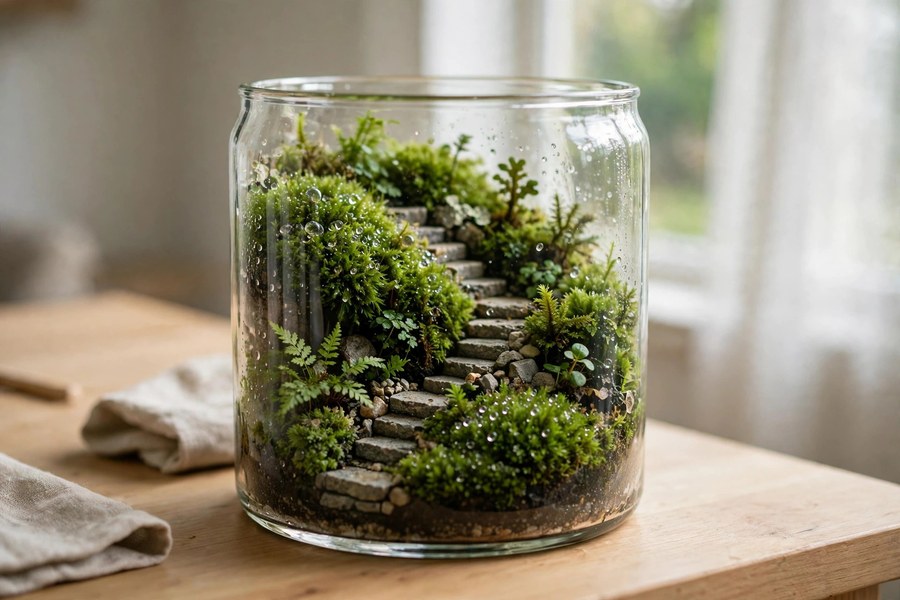
You are hovering over the buy button on a beautiful moss terrarium — soft green hills, a tiny winding path, maybe a miniature stream — and the doubt creeps in: am I about to spend real money on something that dies in a month? If you have killed houseplants before, the worry is fair. Here is the honest answer: with two small habits, a moss terrarium lasts years, not weeks. It is not a bouquet with a countdown. It is a tiny living landscape, and landscapes do not expire — they just need a little weather.
A moss terrarium is a tiny living landscape, and landscapes do not expire — they just need a little weather. Compared with cut flowers (days) or a fussy tropical houseplant (months, if you are lucky), a moss terrarium is one of the longest-lived pieces of living decor you can buy — provided you give it the two minutes a week it actually asks for.
| Care pattern | What happens | Outlook |
|---|---|---|
| Regular misting + bright, indirect light | Slow, steady growth, stays lush | Years |
| Direct sunlight | Glass magnifies the heat, moss scorches and browns | Days to a couple of weeks |
| Forgotten misting for a while | Dries and browns, but usually revives | Dormant, not dead |
| Bone-dry for months | Tissue breaks down for good | Usually not recoverable |
| Overmisted with no airflow | Mold risk climbs | Weeks to months of trouble |
Almost every terrarium failure traces back to one of two things. The first is direct sunlight. It looks harmless through a window, but glass concentrates heat, and moss evolved for filtered forest light — a few days in a direct beam can scorch it beyond easy recovery. A bright room is perfect; a sunbeam hitting the glass is not.
The second is total neglect — not forgetting to mist for two days, but weeks of bone-dry silence. Moss shrugs off a short dry spell without complaint. It cannot shrug off being ignored indefinitely.
This is the part that surprises people, and it is genuinely good news. Moss does not die the way a wilting houseplant does. When it dries out, it usually just goes dormant — crispy, faded, sad-looking — rather than dying outright. Mist it properly for a few days and a surprising number of "dead" terrariums green back up within a week.
One rough, forgetful week almost never means game over. Months of drought might — but that is a different story. The test is simple: mist, wait a week, and watch for green tips before you give up on it.
Keeping a terrarium alive long-term is a routine, not a talent:
That is the whole deal: no repotting schedules, no fertilizer calendars, no pruning expertise. Just mist, light, and a little attention. Before buying, it also helps to know what you are paying for — handmade vs mass-produced terrariums: what you are actually paying for — and whether a terrarium suits your household: moss terrariums and pets: what is actually safe.
Winter is the danger season indoors: heating systems dry the air fast, so misting frequency should go up, not down. Summer's risk is the opposite — a terrarium migrated to a sunnier windowsill for "more light" can cook in an afternoon. The rule stays the same all year: bright room, no direct beam, light misting, done.
If you want movement and animals as well as green, a terrarium may not be the end of the story — moss terrarium vs planted aquarium: which miniature ecosystem is actually right for you compares the two commitments honestly.
Tip: A handcrafted moss microlandscape from CozyWoodLab is built to be that kind of long-term companion — a small green world on your desk that rewards a tiny habit with years of calm, living green.