+

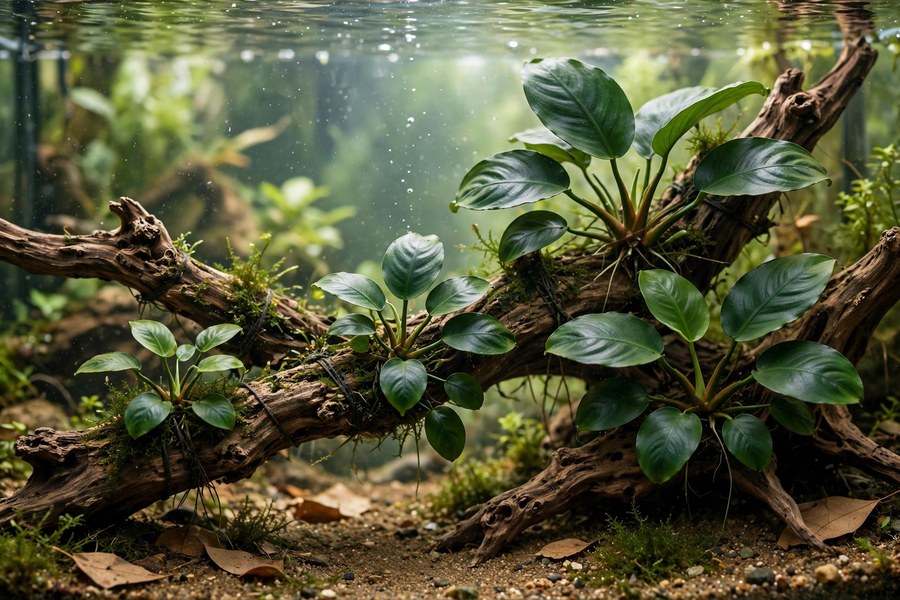
Anubias is arguably the most bulletproof plant in the hobby — it tolerates low light, survives nibbling fish, and grows on wood and rock where other plants fail. But buy the wrong size and your aquascape's proportions fall apart overnight. Here is how the three most popular varieties compare, and how to place each one.
Key takeaways
| Variety | Leaf size | Best tank size | Placement |
|---|---|---|---|
| Nana Petite | Thumbnail-sized | Nano tanks, desktop shrimp bowls | Tucked into hardscape crevices |
| Frazeri Large | Long, narrow, elegant | 20–29 gallon standard | Mid-ground focal point |
| Hastifolia | Massive, spear-shaped | 55 gallons and up | Background, can grow emersed |
If you keep a nano tank or a desktop shrimp setup, Anubias Nana Petite is the detail plant. Its leaves rarely grow bigger than a thumbnail, so you can wedge it into dragon stone crevices or glue it to the tips of spider wood. The effect is a weathered, ancient look that shows off the hardscape instead of hiding it.
One warning: because it is small and slow-growing, it collects green spot algae quickly under high light. Keep it shaded under taller plants or hardscape overhangs, and it will stay clean and compact.
Frazeri Large — a hybrid of Anubias barteri and Anubias congensis — is the classic jungle plant for a standard 20- or 29-gallon tank. Its long, narrow leaves on elegant stems are big enough to anchor a scape as a mid-ground focal point tied to a central piece of driftwood, without blocking light from the foreground.
It is also the answer to destructive fish. If your cichlids or goldfish uproot every delicate stem plant, a thick Frazeri rhizome glued to a heavy rock is practically indestructible — they can tug at it all day and it will not budge. That toughness is why Anubias pairs so well with other driftwood epiphytes like Bucephalandra in a low-maintenance layout.
Do not put Hastifolia in a 10-gallon tank. This is a beast of a plant, with massive spear-shaped leaves on very long stems that look like they belong in a dinosaur film. In a 55-gallon or larger tank, though, it is the ultimate background epiphyte.
In an open-top tank its leaves will happily break the surface and keep growing emersed, giving a wild, overflowing jungle look. Like all Anubias it must be attached to hardscape rather than buried, and it tolerates the same rough treatment from big fish that makes the whole genus so hobbyist-friendly.
The golden rule comes first: never bury the thick, green, horizontal rhizome in gravel or aquasoil — it rots into mush. Tie it to wood or stone, or glue it with a few dabs of aquarium-safe cyanoacrylate gel, and let the thinner white roots find their own way down. Cotton thread also works; it rots away naturally once roots grip.
The second rule is shade. These are slow growers, and bright direct light turns them into expensive algae farms — tuck them beneath taller background plants.
If leaf edges turn black and fuzzy, that is usually black beard algae: cut the lighting hours or move the plant to a dimmer spot. Our algae identification guide helps you confirm the type before treating.
Tip: when you buy Anubias, check the rhizome first — firm and green means healthy, soft or mushy means rot has already started. A healthy rhizome is the whole plant's future, and it will probably outlive the tank itself.
Nana Petite — its thumbnail-sized leaves stay proportional to a small footprint, while Frazeri and Hastifolia will quickly overwhelm a tank that size.
Yes, and it often looks better than a single variety: Nana Petite for foreground detail, Frazeri as the mid-ground anchor, and a larger variety in the background creates natural depth in one aquascape. Getting scale right is half of aquascaping — see our aquascaping tips for more on proportion.
Picking the right Anubias is not about which one looks coolest in a stock photo — it is about scale. Match the plant to your tank, keep the rhizome breathing above the substrate, and give it shade, and you will have a green centerpiece for years. At CozyWoodLab, our driftwood is shaped to show off epiphytes exactly like this: branching pieces with crevices and tips where a Nana Petite or a Frazeri can grip and grow.