+

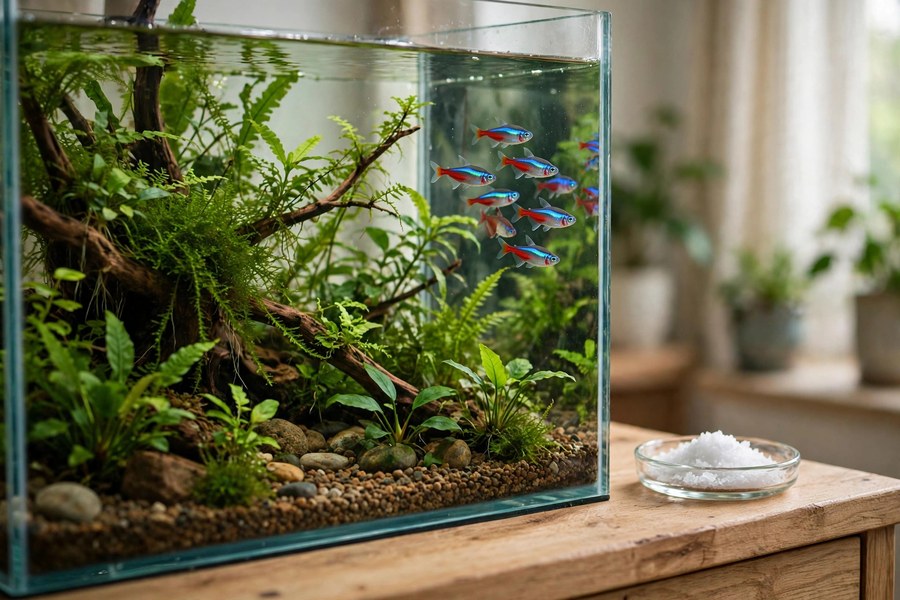
Ask ten fish keepers about aquarium salt and you will get ten different answers: some dose it constantly, others only reach for it when fish fall ill. After years of testing across hundreds of fish, one conclusion stands out — plain sodium chloride is one of the cheapest, most widely available and most effective treatments in the hobby, as long as you respect its limits. Used carefully, it fights bacteria, fungus and external parasites; used carelessly, it can wipe out a tank.
Key takeaways
Salt works by dehydration. Raising the salinity of the water pulls water out of tiny organisms through osmosis, as nature tries to balance the salt concentration on both sides of their skin or membrane. Pathogens are small and hold little water, so they dry out and die before the fish — which is much larger and carries far more stored water — suffers the same fate. Some hardy microorganisms can tolerate higher salinity, so salt is powerful but not a guaranteed cure for everything.
No. Dosing salt daily as a health booster is like a healthy person taking antibiotics every day just in case. Any disease that breaks through your constant salt barrier will tend to be unusually resistant, and curing it may then require a salt concentration that harms the fish. Kept in reserve and used only when needed, salt stays a strong tool; used constantly, it slowly spends its own usefulness.
For this treatment, use normal aquarium salt or plain NaCl rock salt. Table salt often contains anti-caking agents and iodine, marine salt mixes contain a whole cocktail of minerals meant for saltwater, and Epsom salt is magnesium sulfate — a different chemical with different uses. Getting the right salt matters as much as getting the dose right, and all measurements here use US tablespoons and gallons.
Always start at the lowest level and increase only if symptoms persist. Jumping straight to the strongest dose stresses fish that might have recovered gently.
| Level | Dose | What it treats | Notes |
|---|---|---|---|
| Level 1 — mild | 1 tbsp per 3 gallons | Mild bacterial and fungal infections; boosts slime coat | Safe for virtually all fish except anchor catfish; hold 4–5 days |
| Level 2 — moderate | 1 tbsp per 2 gallons | Wider illness range, including ich (white spot) | Ich course runs about 10 days; step up after 5 days if worsening |
| Level 3 — strong | 1 tbsp per 1 gallon | Stubborn cases nothing else has shifted | Hard on scaleless and sensitive species — research first |
Level 1 works a little like antiseptic on a small cut: it is gentle, and it mildly irritates the fish's slime coat so the fish produces extra protective mucus that blocks some parasites. Rasboras, danios, tetras, silver dollars, livebearers and most cichlids — and their fry — tend to tolerate salt well, and even Neocaridina cherry shrimp have proved fairly hardy. Crystal shrimp (Caridina) are less tested, so treat them with extra caution. Salt is generally not compatible with most live plants and snails, so a hospital tank is often the wiser choice.
Salt does not evaporate and filters do not remove it. When water evaporates, the salt stays behind, which means topping off never dilutes a treatment. Only add salt when you change water, and only in proportion to the new water: treating 100 gallons at Level 2 needs 50 tablespoons initially, and a 20-gallon water change needs just 10 more tablespoons added to the replacement water. Overdosing is easy and, unlike most medications, salt does not break down over time.
Keep the salt in until the fish looks healthy, then remove it gradually with water changes rather than all at once:
New fish can be treated at the gentle Level 1 dose for two weeks in quarantine, which clears roughly 60% of potential illnesses before they reach your main tank. The same setup gives injured fish a quiet place to recover. Salt also shines when you cannot identify the disease at all: while a boxed medication targets one problem, salt attacks a broad range of bacteria, fungus and parasites, which is why it matters even more as some countries restrict antibiotic sales for the pet trade. Before you reach for any treatment, though, learn to read your fish — our guide to sleeping versus sick behaviour and the health clues in what fish poop tells you help you judge whether salt is even the right call. New arrivals also deserve the dip-and-quarantine routine in quarantining new plants so pests never enter the tank in the first place.
Used with respect, a simple box of aquarium salt belongs in every keeper's cabinet — and a calm, well-scaped tank from CozyWoodLab, with driftwood caves where recovering fish can rest undisturbed, gives any treatment the best possible chance to work.
Warning: never pour salt directly onto fish, plants or snails, and never guess the dose. Measure every tablespoon, write down the level you used, and remember that salt only leaves the tank when you physically remove water.