+

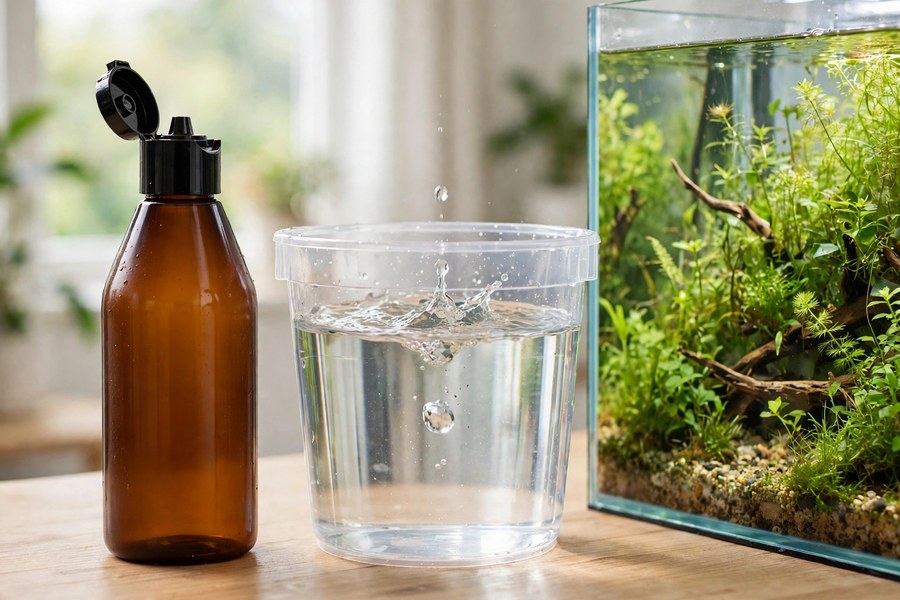
New fishkeepers often treat water conditioner as magic potion: pour it in, and the water is clean, the fish will not get sick. It does not work like that. A water conditioner's real job is making tap water safe for fish to live in — not fixing every water problem. Different types solve completely different problems, and using the wrong one for the wrong situation can mislead you.
| Type | What it does | When to use it |
|---|---|---|
| Dechlorinators / water stabilizers | Neutralize chlorine and chloramine, bind heavy metals like lead and copper | Before every water change |
| Beneficial bacteria starters | Seed the filter with nitrifying bacteria that convert ammonia and nitrite into safer nitrate | New tank, after filter cleaning, after a big water change, during an ammonia crisis |
| Water clarifiers | Clump tiny suspended particles so the filter can catch them | Severe cloudiness only — an emergency cosmetic |
| pH/hardness adjusters and blackwater extracts | Fine-tune acidity and hardness, or add tannins mimicking a rainforest stream | Soft-water species, breeding setups |
Dechlorinators neutralize chlorine and chloramine in tap water and bind heavy metals like lead and copper. Use before every water change: treat the new water in the bucket before it ever touches your tank, so chlorine never burns your fish's gills or wipes out your filter bacteria.
This is the bottle no fishkeeper should skip. Even "safe" tap water is treated with chlorine or chloramine precisely to kill microbes — and your filter bacteria are microbes.
Bacteria starters are living cultures that seed your filter with nitrifying bacteria, which convert toxic ammonia and nitrite into much safer nitrate. Use them when cycling a new tank, after cleaning your filter media, after a big water change that disturbed the bacteria colony, or during an ammonia crisis.
They work best as a head start, not a shortcut: the colony still needs time to establish. If you are setting up a new tank from scratch, read how to cycle a planted aquarium the patient way before you add fish — a bottle of bacteria does not replace cycling.
Clarifiers clump tiny suspended particles together so your filter can catch them, clearing cloudy water fast. These are emergency cosmetics: they make the water look clean but do not replace water changes or filter maintenance. Use for severe cloudiness, then fix the actual cause — overfeeding, weak filtration, or a disturbed substrate.
If the water keeps clouding up, look for the root cause rather than reaching for the bottle again. Cloudy water, odd bubbles, and surface films are all messages from your tank — what every kind of aquarium bubble means helps you read those signs.
pH and hardness adjusters fine-tune acidity and hardness, while blackwater extracts add tannins and humic acids that mimic a South American rainforest stream: soft, slightly acidic, amber-tinted water that lowers stress and boosts immunity. They are great for tetras, dwarf cichlids, and other soft-water species, or for breeding setups.
Do not use these to chase a "perfect" number in a community tank. Stable water that is slightly off beats water that swings every week — fish adapt to consistent conditions far better than to constant adjustment.
The golden rule is "prepare outside, add slowly": test your tank water, fill a bucket with the tap water you need, dose the conditioner by the volume of NEW water (not the whole tank — this is the mistake almost everyone makes), stir it in the bucket so the dechlorination finishes before the water enters the tank, then pour the prepared water in slowly so pH, hardness, and temperature do not swing.
Fold this into a weekly routine and it becomes automatic — the lazy keeper's guide to a clean aquarium shows how little time a proper routine actually takes.
| Situation | Reach for |
|---|---|
| Routine water change | Dechlorinator, every time, no exceptions |
| New tank or new fish | Bacteria starter plus a conditioner with slime-coat protection to reduce transport stress |
| Ammonia/nitrite spike | Full detoxifier plus bacteria starter, immediately |
| Cloudy water | Clarifier for the emergency, then fix the root cause |
| Specific species or breeding | Blackwater extract to recreate their native water |
First, identify the actual problem — cloudy does not always mean missing bacteria, and gasping fish does not always mean low oxygen. Find the cause, then pick the product. Choose products with simple, clearly labeled functions (freshwater or saltwater, dosage, active ingredients, storage) over "does everything" bottles whose functions interfere with each other.
And dose as directed: more is not better, especially with bacteria starters, pH adjusters, and blackwater products — overdosing shocks the water. If you are stocking a new tank, it also helps to know your fish before you buy the bottle: for a hardy beginner species, see zebra danio care, the beginner's guide to this energetic schooling fish.
Tip: Keep one bottle of dechlorinator always in stock and treat it as non-negotiable as the food itself. Running out on water-change day is how untreated tap water ends up in a tank.