+

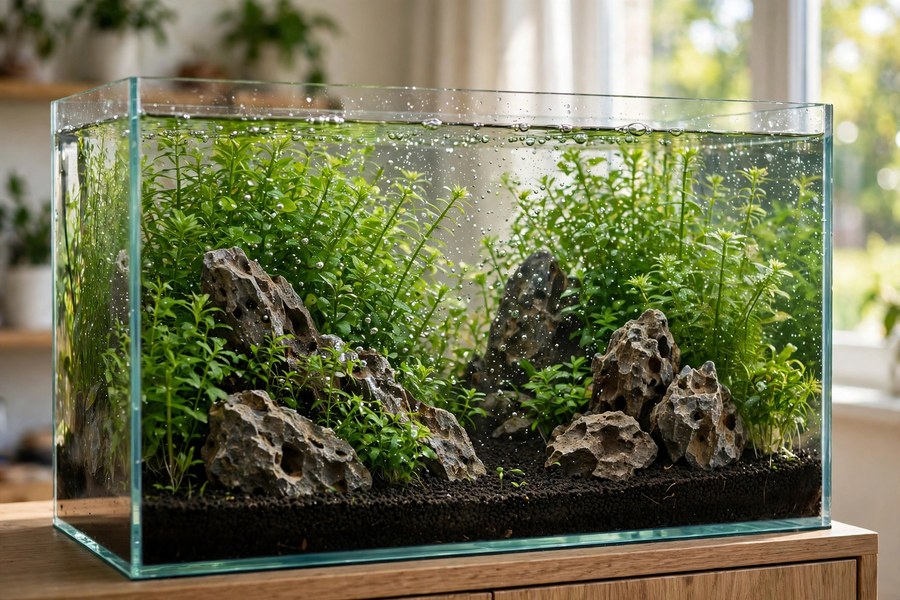
Every new aquarium goes through an awkward first chapter: the water looks clear, the layout is finished, and yet the tank is not ready for fish. Cycling is the process of growing the invisible bacteria that make an aquarium safe — and in a planted tank, that process works a little differently from a bare, fish-only setup. Understanding why helps you stay patient for exactly as long as you need to, and not a day longer.
Fish waste and decaying matter release ammonia, which is toxic even in small amounts. One group of beneficial bacteria converts ammonia into nitrite — also toxic. A second group converts nitrite into nitrate, which is far safer and is removed by water changes. A cycled tank is simply a tank where both bacterial colonies are large enough to keep ammonia and nitrite at zero around the clock.
| Stage | Compound | Toxic? | What handles it |
|---|---|---|---|
| 1. Waste breaks down | Ammonia | Yes, even in small amounts | First bacterial colony + growing plants |
| 2. First conversion | Nitrite | Yes | Second bacterial colony |
| 3. Second conversion | Nitrate | Far safer at normal levels | Water changes + plant uptake |
Here is the twist: growing plants feed on ammonia directly, and they take it up eagerly because it is an easy source of nitrogen. A densely planted tank therefore has a living filter running alongside the bacterial one, soaking up part of every ammonia spike before it can build up.
That makes the planted cycle more forgiving — but it does not make it optional. Plants rest at night, leaves melt and regrow, and no plant bed can absorb a sudden shock, like a full stock of fish added in one day. You still need the bacterial colony, and you still need a real filter full of porous media where that colony can live.
For the planting itself, start with easy species that need no injected CO2: 10 easy aquarium plants that grow without CO2. And if you are adding new plants during the cycle, dip and quarantine them first — the dip-and-quarantine routine keeps snail eggs out of the new tank.
Most planted tanks take roughly three to six weeks to stabilise. Nutrient-rich active aquasoils often release some ammonia during the first weeks; in a fish-only tank that would be a hazard, but planted heavily from day one, it quietly feeds both your plants and your growing bacteria.
| Phase | What is happening | What you do |
|---|---|---|
| Weeks 1–2 | Ammonia rises, first bacteria establish, some plant melt is normal | Plant generously, test every few days, trim decaying leaves |
| Weeks 3–4 | Nitrite appears, then starts falling as the second colony grows | Keep testing, small water changes if readings spike, resist adding fish |
| Weeks 5–6 | Ammonia and nitrite settle at zero, nitrate rises slowly | Confirm zero readings on several consecutive days, then stock slowly |
Plant generously at the start — a few lonely stems cannot process a whole tank of water — and favour fast-growing species early on, because rapid growth is what outcompetes the algae bloom that tries to visit almost every new setup. If algae does show up, identify it before treating: identify your algae type first, then fix the root cause.
Never judge by how the water looks. Judge by numbers: use a liquid test kit, and consider the tank cycled when ammonia and nitrite both read zero on several consecutive days. Some early plant melt is normal during this period — many plants are grown out of water at the nursery and shed those leaves as they adapt to life submerged. Trim away soft, decaying leaves so they do not add to the ammonia load.
Treat any tap water used for changes with a dechlorinator first, or chlorine will set your young colony back — what each type of water conditioner actually does explains which bottle to use.
Adding fish "just to test". If the tests are not at zero, the fish pay for the experiment. Wait for the numbers.
Stocking all at once. Even a finished cycle is young. Add livestock in small groups, a week or so apart, so the bacteria can grow with the load. A hardy first species is ideal — zebra danio care explains why a small school makes a great first addition.
Skipping the filter because "the plants handle it". Plants and filter media are partners, not rivals. The filter is your safety net for the moments plants cannot cover.
Tip: Give the tank its few quiet weeks, test instead of guessing, and you will be rewarded with something better than a decorated glass box: a small, self-supporting ecosystem that stays stable for years. Keep it stable afterwards with a simple routine — the lazy keeper's guide to a clean aquarium.