+

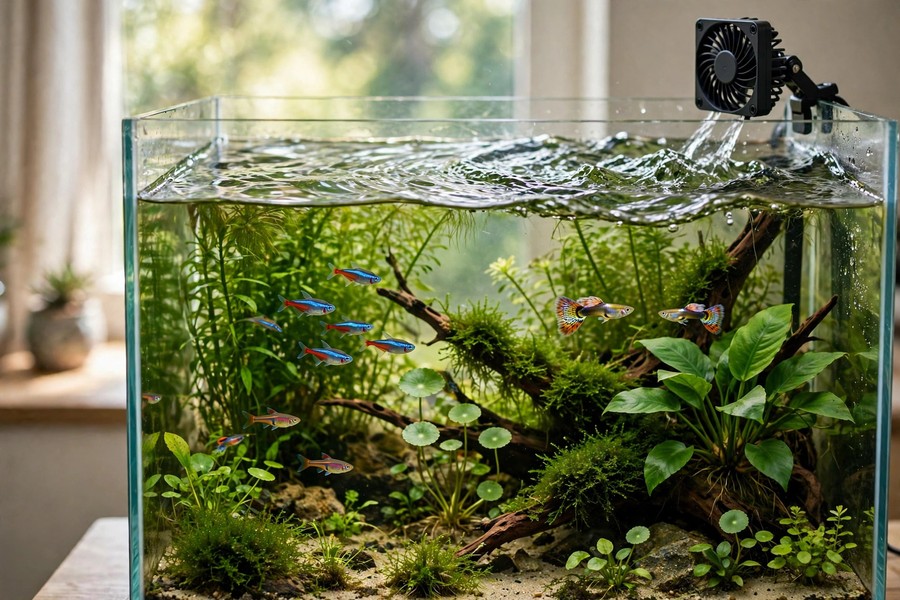
When summer arrives, a fish tank can turn into a warm soup faster than most keepers expect. Rising water temperature is not just a comfort issue: warm water holds less oxygen, speeds up fish metabolism, and leaves the whole tank more vulnerable to disease. A little preparation before the first heatwave keeps the difference between a stressful summer and an uneventful one.
Key takeaways
Temperature controls two things at once: how much oxygen water can carry, and how fast a fish burns energy. As water warms, its oxygen capacity falls while fish breathe faster and produce more waste. That is why a tank that looked perfectly fine in spring can suddenly show fish gasping at the surface on a hot afternoon.
High temperatures also weaken immune defences, so problems that a healthy fish would shrug off — a minor bacterial bloom, a trace of ammonia — can turn serious in days. Summer trouble rarely arrives as one dramatic event; it builds quietly until one hot week pushes the tank over the edge.
Most tropical fish tolerate around 28°C, but the margin above that is thin, and some residents have almost none. Knowing your most heat-sensitive stock tells you how urgently you need to act.
| Resident | Heat sensitivity | What to watch for |
|---|---|---|
| Ornamental shrimp (cherry, crystal shrimp) | Very high — trouble above 28°C | Shrimp darting, climbing out, or dying in groups |
| Cool-water fish (white cloud mountain minnow, some danios) | High | Faded colours, lethargy, loss of appetite |
| Most tropical community fish | Moderate — cope to about 28°C | Fast gill movement, hanging near the surface |
| Aquatic plants | High above 30°C | Yellowing, rotting, or melting leaves |
The simplest and most common fix is a clip-on aquarium fan that blows air across the surface. Moving air speeds evaporation, which carries heat away, and a fan setup usually lowers the temperature by 2–3°C. The trade-off is faster water loss, so top up more often and keep an eye on water parameters as the level drops.
Because warm water holds less oxygen, adding air is cheap insurance. Run an air pump around the clock with a fine air stone so the surface stays rippled day and night. Surface movement also helps waste gases escape and keeps circulation going when fish need it most. If you are unsure whether your current is helping or hurting, our guide to reading aquarium water flow shows how to judge it.
When fans hit their limit — a poorly ventilated room, or especially delicate stock — a water chiller is the definitive answer. Like a small air conditioner for the tank, it holds a set temperature regardless of the weather. Semiconductor mini chillers suit small to medium tanks, run quietly, and sip power compared with compressor models.
Small daily habits add up to real degrees. Keep the tank out of direct sunlight — draw the curtain or move it off a sunny balcony. Shorten lighting hours in summer, or switch to low-heat LED lighting. And step up water changes to every 5–7 days, topping up slowly with water 1–2°C cooler than the tank, which cools gently while diluting waste.
| Method | Typical cooling | Best for | Watch out for |
|---|---|---|---|
| Clip-on fan | 2–3°C | Most home tanks, quick fix | Faster evaporation — top up often |
| Extra aeration | No direct cooling | Every heated tank, as backup | Does not replace real cooling |
| Water chiller | Precise, any target | Delicate stock, hot rooms | Higher cost and power use |
| Shade + shorter lights + water changes | 1–2°C combined | Every tank, zero cost | Never change water with very cold water |
Fish gasping at the surface, clamped fins, sudden loss of appetite, or shrimp deaths are the classic heat alarms. If you see them, act the same day: shade the tank, start a fan, increase aeration, and do a gentle partial water change with slightly cooler water. Never dump ice or very cold water straight in — a sudden temperature crash shocks fish worse than the heat itself.
Tip: keep a thermometer you actually look at. A stick-on strip or a simple digital probe costs almost nothing, and checking it each evening in summer turns a silent problem into a visible one.
Keeping a tank cool in summer is mostly about planning, not gear. Shade and airflow handle most tanks, aeration covers the oxygen gap, and a chiller waits in reserve for the setups that truly need it. At CozyWoodLab, we think of summer care the same way we think about hardscape: get the environment right first, and everything living in it has a much easier time.