+

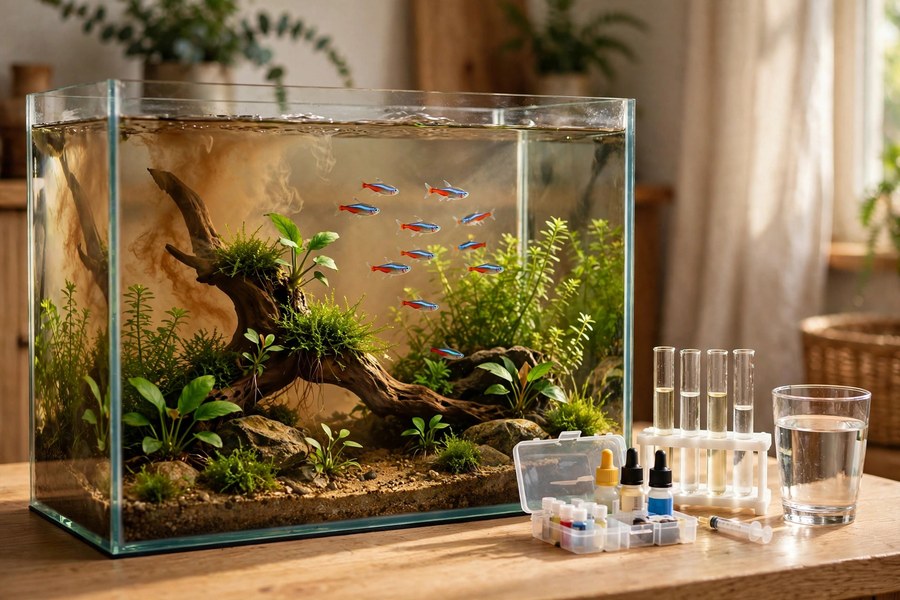
Hard water is one of those invisible aquarium problems: the fish look fine, the tank looks clear, and yet white crust keeps appearing on the glass and some species never quite thrive. The fix starts with understanding what hardness actually measures, which fish care about it, and how to lower it gently. This guide turns a practical Taiwanese fishkeeping article into a step-by-step plan for softer, steadier water.
Key takeaways
Hard water simply contains more dissolved minerals, chiefly calcium and magnesium, while soft water contains far fewer. General hardness (GH) puts a number on that difference: 0–6 GH is soft, 11 GH and above is hard, and the middle band suits many community fish. A test kit for your tap water is therefore the first step, before any softening method, because you cannot fix a number you have not measured.
Hard water leaves its signature everywhere: white lime deposits on glass and equipment, and a tendency for pH to drift out of balance. For sensitive species it can slow growth, add stress and open the door to illness, while soft water stays closer to neutral and suits a wider range of delicate fish. The link to pH matters here too, since unstable hardness often means unstable pH, and that instability is what fish feel most.
Not every tank needs soft water, and chasing it for fish that do not need it only adds work. The species that genuinely benefit are the classic soft-water community fish: tetras, glass catfish and South American dwarf cichlids, for which soft water reduces stress, supports immunity and encourages breeding. Hard water, by contrast, can leave plants struggling and fish underdeveloped when it pushes conditions too far from what they evolved for.
At the other end, livebearers such as guppies, platies and swordtails are much more forgiving of hard water, which is one reason they suit beginners with mineral-rich tap water. The practical rule is to start from the fish you already keep, learn what they prefer, and adjust gradually from there — not to copy a soft-water recipe meant for someone else's stocking. If you are still choosing fish, our guide to cycling a planted aquarium is the right place to start, since a stable, mature tank makes any water adjustment far safer.
| Fish group | Hard-water tolerance | What to do |
|---|---|---|
| Tetras, glass catfish, dwarf cichlids | Low — prefer soft water | Soften gradually toward their range |
| Guppies, platies, swordtails | High — tolerate hard water | Often no softening needed |
| Shrimp and snails | Need some calcium | Soften gently; never remove all minerals |
The gentlest softening methods work with nature rather than against it. Rainwater is naturally soft because it carries almost no dissolved minerals, so collected in a clean container it can be mixed with tap water for water changes — though in industrial areas it should be filtered first, and supply depends on the weather. Peat moss, boiled for two to three minutes to sterilise it and placed in the filter, slowly absorbs calcium and magnesium ions while releasing tannins that tint the water yellow, a colour that is harmless and even beneficial to fish.
Driftwood does the same job while also shaping the scape: as it releases tannins it naturally softens the water, provided it is disinfected first to avoid parasites, and given enough aeration to discourage mould. A natural driftwood centrepiece from CozyWoodLab therefore does double duty, giving soft-water species the shaded, wood-strewn habitat they recognise while gently nudging the chemistry in their favour. Our driftwood bonsai guide shows how to place wood so it looks like an ancient tree rather than a random log.
| Natural method | How it works | Watch out for |
|---|---|---|
| Rainwater | Naturally low in minerals; mix with tap water | Unreliable supply; filter it in polluted areas |
| Peat moss in the filter | Absorbs calcium and magnesium; releases tannins | Water turns yellow temporarily |
| Driftwood | Releases tannins that soften water naturally | Disinfect first; watch for mould, add aeration |
When tap water is very hard, the professional-grade answer is a reverse osmosis (RO) system, which strips out most minerals to produce very pure soft water. That purity is also its catch: minerals must be added back with a remineralising salt, the system wastes water, and the equipment costs more — but for a dedicated soft-water tank it gives the steadiest results over time. For smaller tanks, a simpler option is a softening pillow or resin placed in the tank, which absorbs minerals directly and can be recharged by soaking in salt water, though large tanks need several pillows and more patience.
Whichever method you choose, three habits keep it safe. Test GH and pH after softening so the water does not end up too soft for the fish in it. Change water gradually rather than replacing it all at once, so the shift never shocks the stock. And if you keep shrimp or snails, make sure calcium stays available, since those animals need it for shells and moults even in a soft-water tank.
Tip: test your tap water before you buy anything. Many keepers soften water they never needed to soften — a single GH reading tells you whether rainwater and driftwood will do, or whether RO is genuinely worth the investment.