+
.png)
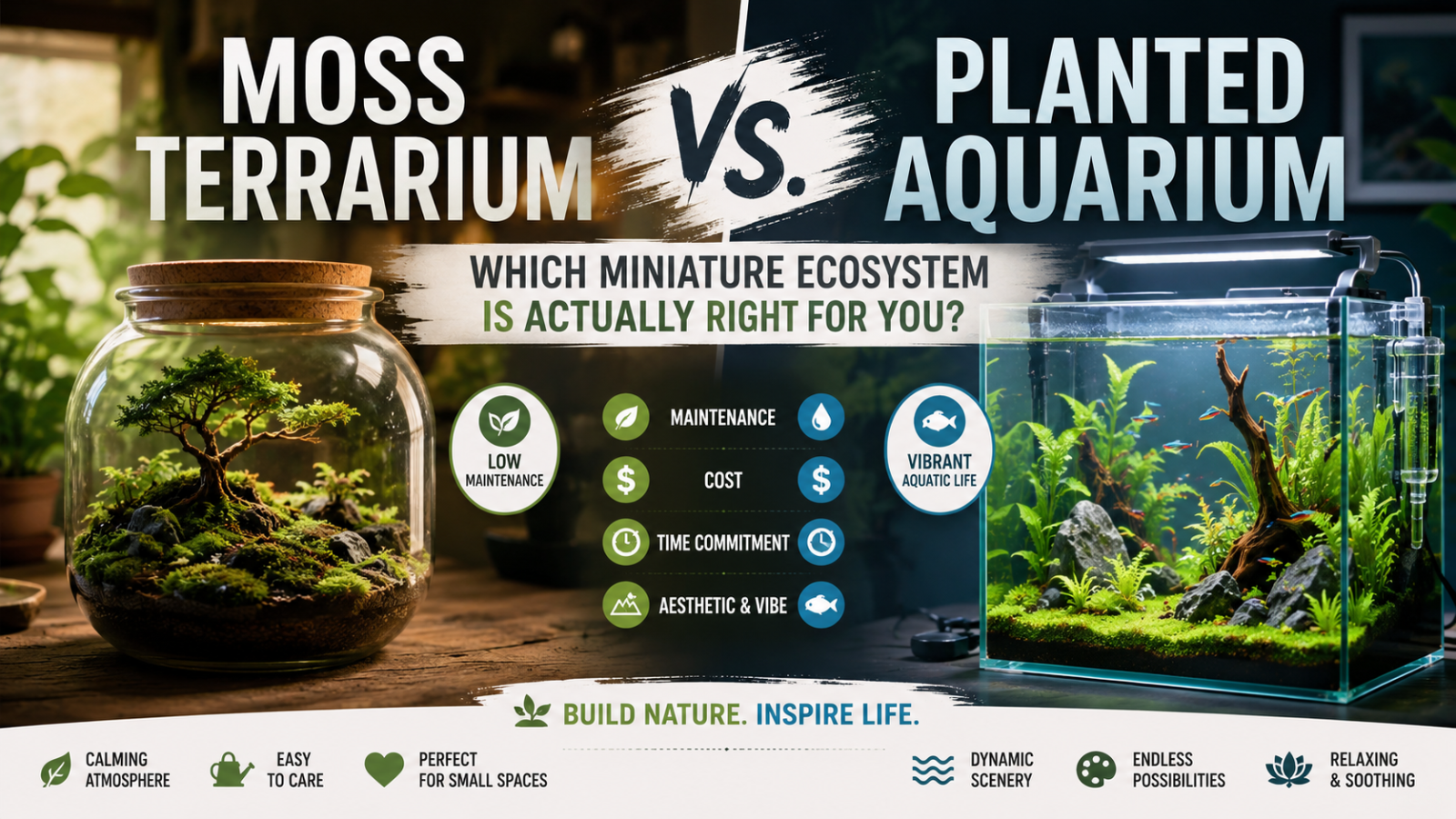
Most people size their driftwood by eye at the fish store, drop it in the tank, and wonder why the whole scape looks wrong. Too big and the wood swallows the layout. Too small and it disappears against the substrate like a pebble. In a 5- or 10-gallon nano tank, there's almost no margin for error — one oversized piece and the whole thing falls apart.
I've rescaped the same 30P three times chasing the right wood-to-tank ratio. Here's what actually works.
A 75-gallon tank is forgiving. Drop in a piece of mopani that's slightly too wide and the open water absorbs the mistake. A 5-gallon cube has no such buffer. Every element — wood, stone, plant, fish — is in direct visual competition with every other element, crammed into a space roughly the size of a shoebox.
The wood is your anchor. It sets the mood, defines the focal point, and — critically — determines how much usable space remains for plants and livestock. Get the size wrong and no amount of clever planting rescues the scape. Get it right and even a $5 piece of random driftwood from the LFS can look like a deliberate ADA-style composition.
Scale isn't just visual, either. An oversized piece of wood in a pico tank displaces water volume, reduces swimming corridors, and can spike tannin release faster than the tiny water column can buffer — a real issue for shrimp tanks where stability matters more than aesthetics.
Here's a breakdown built for the sizes most desktop and nano hobbyists actually run:
Pico tanks (under 5 gallons / under ~18L)
These are 2.5-gallon cubes, rimless 4-gallon bowls, the kind of setups that live on a bookshelf or windowsill. Main focal piece: 3–6 inches max. Accent pieces: 1–2 inches. You're looking at nano spider wood twigs, small manzanita offcuts, or thin cholla sections. A single branching piece at 4–5 inches, positioned off-center with a carpet of Java moss, is enough. Anything larger dominates the entire tank and leaves no visual breathing room.
True nano (5–10 gallons / ~20–40L)
This is the sweet spot — 5-gallon cubes, 8-gallon rimless, standard 10-gallon rectangles. Main piece: 6–12 inches. The 10-gallon footprint (20" × 10") can handle a 10–12 inch centerpiece piece well, particularly branching wood with vertical reach. Supplement with one or two accent pieces at 3–5 inches each. This is where spider wood really shines — a single well-branched piece at 8 inches can fill the midground and upper zone simultaneously.
Large nano (15–20 gallons / ~55–75L)
The ADA 60P (60cm / 23.6 inches wide) sits here. These tanks are the most forgiving in the nano category. Main piece: 12–18 inches. You can go multi-piece compositions — a primary and secondary wood element — with real textural variation between them. Malaysian driftwood starts to make practical sense at this size; its denser, darker mass creates a strong anchor without looking cramped.
A simple guideline that works across all sizes: your main wood piece should span 60–70% of the tank's longest dimension.
For a 20-inch long 10-gallon tank, that's 12–14 inches for the piece itself — but that's the total spread including branches, not just the trunk base. A 9-inch spider wood piece with branches extending another 4–5 inches easily covers that range. For a 12-inch wide pico cube, 60–70% is 7–8 inches — which is why the 6-inch recommendation above is actually quite generous for the vertical orientation most pico scapes use.
When do you break the rule? The single exception is a minimalist or "wabi-kusa adjacent" layout where one dramatically oversized piece — say, 85–90% of tank length — is the entire visual statement. No carpeting plants, minimal substrate mounding, maybe one clump of Bucephalandra glued to the wood. I've done this in a 5-gallon and it works precisely because the oversizing is intentional — the wood is the scape. But it's a high-commitment choice. Any plant mass you add will fight the wood for dominance rather than complement it.
Not all driftwood is available in nano-appropriate sizes. This frustrates a lot of hobbyists who find that most LFS stock skews toward 12–20 inch pieces suited for 30+ gallon tanks.
Spider wood (Azalea root) — The best nano option, full stop. Its branching structure looks proportional even at 5–6 inches, and it's easy to find in genuine pico and nano sizes. Leaches tannins moderately — boil once, soak for a week, and you're good. Soft water and low pH tanks (blackwater setups, shrimp tanks) can skip tannin removal entirely.
Manzanita — Similar branching character to spider wood, slightly paler. Comes in small sizes down to 4–5 inches. Pieces can be trimmed with pruning shears without destroying the shape, which makes it the most flexible option for custom fitting. Sinks relatively fast after a proper soak — average 3–4 days.
Cholla wood — Hollow tube structure, 3–6 inches long, perfect for pico tanks. The internal hollow becomes a shrimp highway and a moss attachment surface. It breaks down faster than hardwoods, typically needing replacement after 12–18 months. For a pico shrimp tank, though, it's nearly perfect.
Malaysian driftwood — Dense, dark, heavy. Excellent for 10+ gallon setups but genuinely hard to find in nano-appropriate sizes. If you do find a compact piece (under 8 inches), grab it — the dark mass anchors a midground beautifully. I've had the same 7-inch piece in my 12-gallon for three years without any degradation.
Pacific wood / finger wood — Pale, knotty, open structure. Great for airy forest themes. Available in small sizes but less common than spider wood. Pairs well with bright carpeting plants where the light wood color doesn't create too much visual contrast against the substrate.
Getting the size right is step one. Positioning is step two — and in a nano tank, the two are inseparable.
Off-center is non-negotiable. Dead center wood placement in a small tank looks like a decoration, not a scape. Apply the golden ratio: position your main piece at roughly the 60–65% mark along the tank's length. In a 10-gallon, that's about 12–13 inches from one side wall.
Angle creates depth. Lay the wood on a slight diagonal rather than parallel to the front glass. Even a 15–20 degree angle from front-to-back adds perceived depth, which is in short supply in a 10-inch deep tank.
Use vertical reach. In nano tanks, height compensates for limited footprint. A piece that reaches 70–80% of tank height creates visual drama without occupying floor space. Spider wood and manzanita are naturals for this — their branching structure reads as vertical movement even when the base is compact.
Leave foreground open. The single most common layout mistake in nano tanks: wood placed too far forward, blocking the natural swimming corridor and eliminating foreground planting space. Push the wood to the midground-to-background zone, and leave the front third of the tank clear. Your Monte Carlo carpet or Hemianthus callitrichoides will thank you.
Use two pieces instead of one large piece. A primary piece (the anchor) and a secondary piece (a satellite) at roughly 1:2 or 1:3 scale ratio almost always looks more natural than a single large element. The human eye reads "forest floor" rather than "placed decoration." Position them at the same golden ratio point but at slightly different heights and angles.
The piece looks fine in the bag, huge in the tank. Classic. The bag or bucket gives no spatial reference. Before you buy, measure the tank's interior width and length, carry those numbers to the shop, and hold the wood against a ruler — not your hand — before committing. Or buy online from vendors who photograph each individual piece with a ruler in frame.
The wood floats. Happens with freshly sourced spider wood and manzanita constantly. Don't glue it down out of frustration before curing properly. Boil for 1–2 hours, soak for 5–10 days with daily water changes. Still floating? Anchor to a flat piece of lava rock or dragon stone with super glue gel and bury the base under substrate. The rock anchor disappears; the wood looks natural.
The scape looks crowded after plants fill in. This is a sizing issue disguised as a planting issue. When you're designing the initial hardscape, mentally project forward 6–8 weeks of plant growth. Anubias barteri will double in leaf mass. A Java fern clump will spread 3–4 inches outward. If the scape looks slightly sparse at setup, it will probably look balanced at maturity. If it already looks full at setup — the wood is too large.
Tannin crash in a pico tank. A piece of spider wood that's fine in a 20-gallon can stain a 2-gallon dark brown within 24 hours. In very small tanks, always pre-cure wood fully before adding it. If the water turns tea-colored after a proper cure, that's normal and mostly harmless for hardy species — but it will stress fish that prefer clear water. Do a 40–50% water change and add activated carbon for 48 hours.
Start with a tape measure, not a photo. Know your tank's interior dimensions before you walk into any shop or browse any listing. For a 10-gallon, you're looking for a main piece in the 8–12 inch range. For a 5-gallon, keep it under 7 inches. For a pico, 3–5 inches is your working window. Get that number right first — everything else (wood type, shape, tannin prep, placement) is a detail you can refine.