+

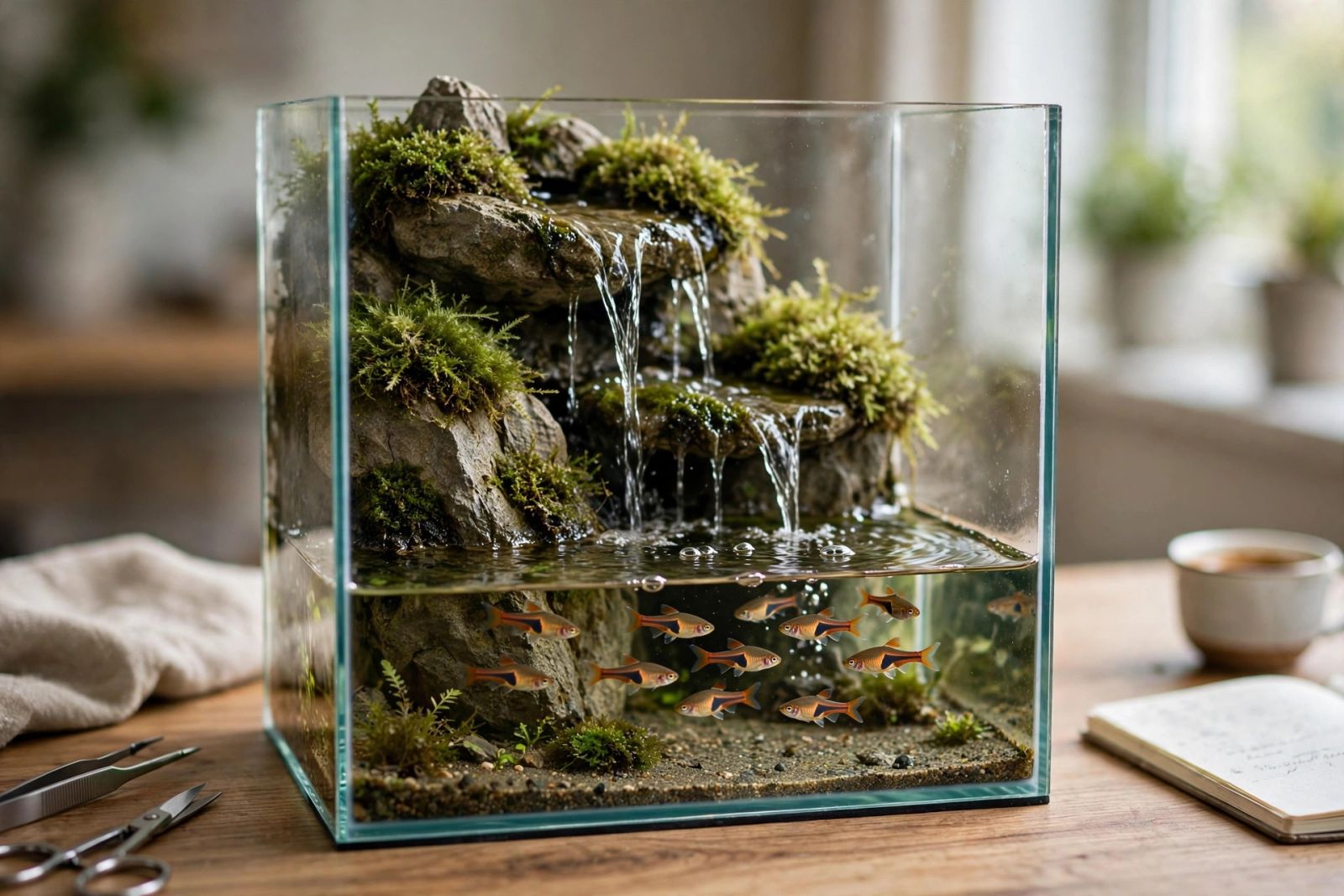
Rocks placed, a few stems planted, water in. Beautiful — and somehow a little still. Most micro-tanks look like a quiet still-life because everything in them is frozen: the hardscape does not move, the water does not move, and the whole scene asks your eyes for attention without giving them anything to follow. Add one moving element and the energy shifts completely.
A nano aquascape has everything except movement. The hardscape does not move, the water does not move, and the whole scene asks your eyes for attention without giving them anything to follow. That is why even a well-planted micro-tank can feel like a photograph rather than a living landscape.
A gentle trickle of water changes that instantly. Movement gives your eyes a path to follow, sound gives the tank presence in the room, and the whole scape starts to feel like a place rather than a display.
Recreating a stream used to mean noisy DIY plumbing, ugly plastic tubes, and messy foam holding everything together. A dedicated running-water feature takes that headache away: a weighted resin structure with a molded water spillway and a textured, moss-compatible surface, sized for a desktop tank.
What makes it work is the texture. Instead of looking like fake plastic decor from a big-box pet store, the surface is molded with natural nooks and crannies designed for live moss and epiphytes. Press small tufts of Java Moss or Christmas Moss directly onto the top ledges, and over a few weeks the moss roots into the stone — turning bare resin into a lush, emerald-green canopy that looks like it has been growing there for years.
| Approach | Setup time | Look | Maintenance |
|---|---|---|---|
| DIY plumbing + foam | A full weekend | Often shows tubes and foam | Hard to clean, noisy if clogged |
| Dedicated water feature | Minutes | Textured surface moss grows over | Swish the intake filter at water changes |
| Open terrarium moss wall | An afternoon | Lush, but no moving water | Hand-spraying every couple of hours |
Choose moss that suits your tank: Java Moss is the forgiving classic, and Christmas Moss gives a tidier, branching look. Both grow without injected CO2 — see 10 easy aquarium plants that grow without CO2 for more low-demand planting choices.
Here is the part people do not expect: as water cascades down the spillway, it constantly hydrates the moss. That keeps the moss vivid and thick without the hand-spraying an open terrarium moss wall demands every couple of hours. The feature is essentially a self-watering moss canopy.
That constant moisture is also why the moss establishes so fast on a water feature compared with a dry-start wall. The roots stay wet, the tips stay green, and the canopy fills in week by week.
A trickle should sound like a stream, not a sputtering tap. The most common cause of noise is a clogged intake filter. During your regular water changes, just swish the internal intake filter in old tank water — that one habit keeps the spillway smooth and quiet.
Flow matters beyond noise too: too much current stresses fish and flattens plants, while dead spots collect debris. If you are unsure whether your flow is right, see how to tell if your aquarium current is too strong, and fold the filter swish into a simple weekly routine like the lazy keeper's guide to a clean aquarium.
Use aquarium-safe resin only: non-toxic material that will not leach chemicals or alter water chemistry is safe for bettas, dwarf shrimp and snails alike. If a structure ships without moss pre-attached, that is actually the point — you get full creative freedom to choose the moss species that fits your design.
For a betta tank, pair the feature with soft, broad plants the fish can rest on — best live plants for a betta tank lists the safest choices.
Tip: Moving water is the fastest way to make an aquascape feel alive. Pair it with handmade natural hardscape — the kind of textured driftwood and rockwork CozyWoodLab crafts for aquascapers — and a simple desktop tank becomes a miniature canyon with a living stream running through it.