+

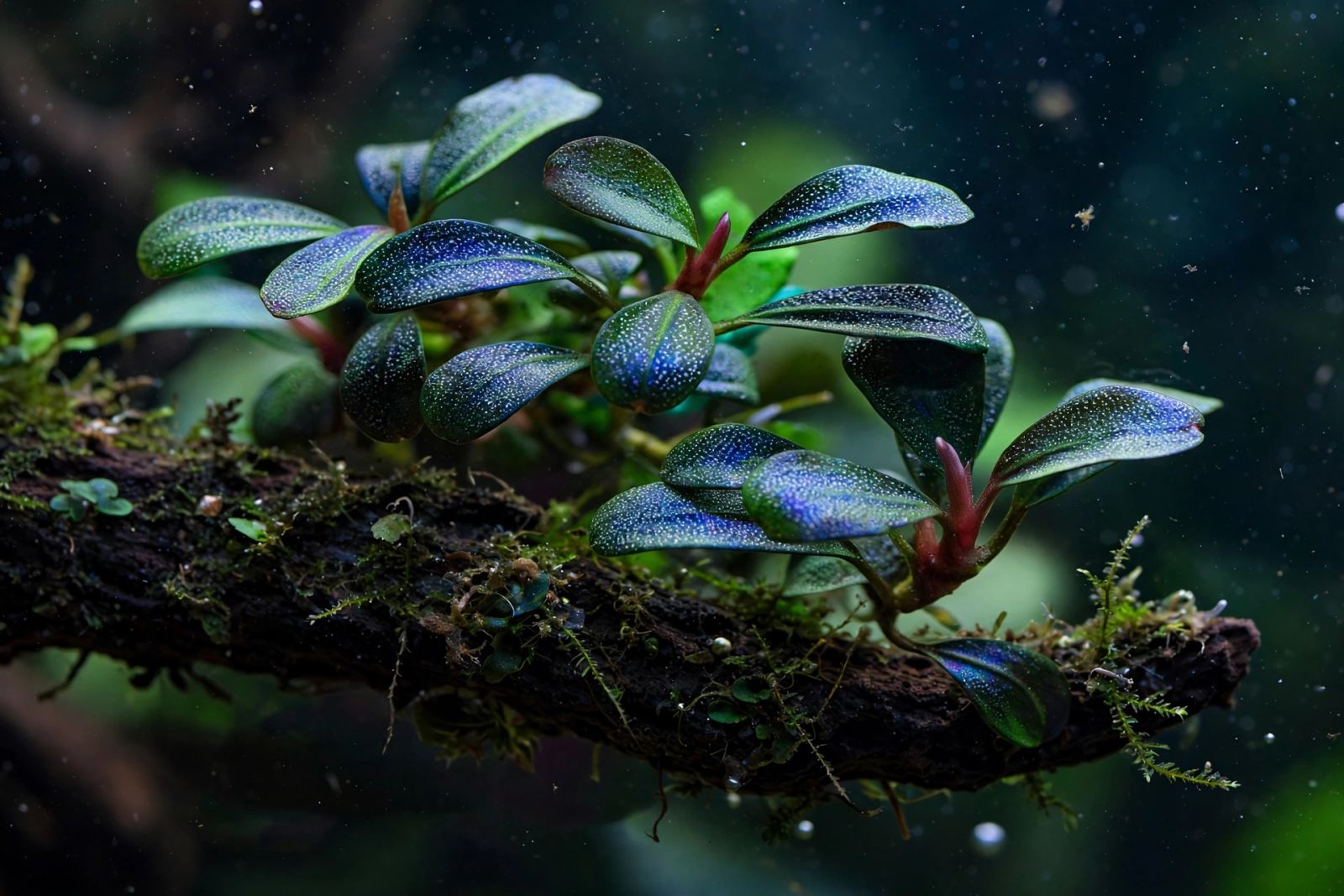
You have seen the photos: deep green leaves shot through with blue and violet, tiny white speckles catching the light, the whole cluster looking less like a plant and more like something carved from rock. That is Bucephalandra, a slow-growing rhizome plant from Borneo, and it is one of the few aquarium plants that genuinely earns its reputation.
It also has one of the highest kill rates among beginner epiphytes — not because it is demanding, but because of a single rule people keep breaking.
Buce grows from a thick horizontal stem — the rhizome — from which the leaves and roots emerge. Bury that rhizome in aquasoil or gravel and it rots, quietly, from the inside. This one mistake kills more Bucephalandra than bad lighting, bad water chemistry and missing fertilizer combined.
Instead, attach it to rock or driftwood and let the roots grip on their own. A dab of gel superglue sets underwater and does the job in seconds; dark cotton thread works too. If you have ever kept Anubias, the rule is identical — see best live plants for a betta tank for Anubias care in detail.
| Factor | Target |
|---|---|
| Light | Low to moderate — brighter light deepens color but invites algae onto slow leaves |
| Temperature | 22–28°C — comfortable in any standard tropical setup |
| pH | 6.0–7.5, adaptable like Anubias |
| CO2 | Not required — only speeds up an inherently slow plant and helps color |
| Feeding | Through the leaves — liquid fertilizers in the water column work best |
Buce belongs on the easy list: 10 easy aquarium plants that grow without CO2. Because it feeds from the water column, it also shows nutrient problems early — yellow leaves? Your aquarium plant is telling you what it needs explains the clues.
| Traditionally grown Buce | Tissue culture Buce | |
|---|---|---|
| Pests | Pond snails, snail eggs, algae spores, occasional planaria | None — grown sterile in vitro |
| Value | One clump | Multiple small plants per cup, easier to scatter across driftwood |
| Wild impact | Collecting pressures Borneo's native populations | Lab-propagated, no wild pressure |
| Transition | Already submerged, less melt | Some melt expected as it switches to underwater growth |
Traditionally grown Buce arrives with baggage: pond snails, snail eggs, algae spores, the occasional planaria — all riding in on a plant you paid a premium for. One bad purchase can seed a snail population you will fight for a year. For traditionally grown plants, the protection routine is the dip-and-quarantine routine.
Tissue culture skips all of that. The plants are grown in vitro in sterile lab conditions, which means no pests, no algae, no contaminants. You also get multiple small plants per cup instead of one clump — better value, and easier to scatter across several pieces of driftwood for a natural look.
There is a quieter reason, too. Buce grows extremely slowly in the wild, and rising popularity has pushed collectors to overharvest Borneo's native populations. Lab-propagated plants take that pressure off entirely.
Tissue-culture plants are grown out of water, so when you submerge them, some leaves will fade and drop while the plant switches to underwater growth. That is transition, not failure — as long as the rhizome stays firm, new leaves will follow.
And one more honest note: Buce usually arrives greener than the dramatic blue-purple photos you have seen. That color develops over months under stable light. Anyone promising instant purple is selling you something. Slow leaves plus strong light equals algae — if algae appears, identify your algae type first, then fix the root cause.
Tip: Bucephalandra rewards patience more than skill. Keep the rhizome on the wood, keep conditions steady, and resist the urge to fiddle — that is genuinely most of it. At CozyWoodLab, our handmade driftwood pieces are built exactly for plants like this: textured, aquarium-safe surfaces that epiphytes grip naturally, so your Buce starts beautiful and stays that way. For driftwood layout inspiration, see how to bring ancient trees underwater with driftwood bonsai.